
Chapter 1 from Psion Power Buch – History of Psion
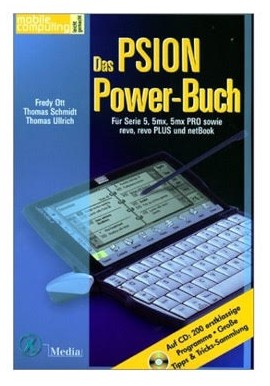
The following text is Chapter 1 from the book Psion Power Buch – Geschichte Psions (ISBN 3932888162). It has been translated using AI and subsequently reviewed by one of the book’s authors, Thomas Ullrich.
Thomas, a prominent member of the German Psion community Psion Welt, has kindly granted permission for this text to be published here.
Introduction
Via the company’s development from a small software house to the UK’s largest computer manufacturer in the UK, one can demonstrate the innovative strength of PSION, and particularly its founder. The comprehensive overview of the product ranges extends to the very latest devices, some of which are still at the announcement stage.
The History of PSION
PSION’s history began around 1980 – at a time before the well-known handy pocket computers. And as is so often the case, it took a charismatic individual who was determined to realise his vision at any cost. In this case, it was a university professor with a select group of students (or should we say followers?) who took the plunge into entrepreneurship.
The Founder
Dr David E. Potter, tall, slim, born 1943, is the founder and chairman of PSION Plc. By his own definition, he is both a rebel and academic who held a professorship in Mathematical Physics at Imperial College London. After years of teaching (including at the University of California), he did everything he could to raise money to set up a company.
With start-up capital of £100,000, he founded PSION in 1980 on London’s Baker Street, which invented the first Organiser as early as 1984. Another stroke of genius was undoubtedly the realisation that the EPOC operating system should form the basis of the joint venture Symbian, which not only brought together all the major mobile phone manufacturers, but could even offer serious competition to the Microsoft empire at the PDA market. David Potter and his family currently hold approximately 19% of the shares in a company with a market capitalisation of around 1 billion GBP.
The name ‘PSION’
There are already many legends surrounding the company name PSION. Perhaps least plausible but most humorous is the following story of how the now iconic brand name:
David Potter wanted to register “Potter Scientific Instruments” as a three-letter company “PSI” when he founded the company. However, when he discovered at the solicitor’s that ‘PSI’ was already taken, he is said to have become annoyed and added ‘ON’ – standing for ‘Or Nothing’ – to ‘PSI’.
So far, no one has been able to provide the PSIONwelt team a more convincing explanation for the meaning of the letters ‘ON’ in PSION. Even the marketing department in England thought that this at least captured the fresh spirit that prevailed at PSION!

The graphic design for long time in use with the symbols that appear cryptic at first glance in the logo was created back during the software development phase.
The symbols above the letters are the individual graphic components of the characters below them.
The Beginning
The history of PSION begins in 1980. PSION started out as a software development company – for a device known not only in the UK: the Sinclair ZX81. Even with this first affordable home computer, with what would be unimaginable today only 1 kB of RAM, games were the key marketing success. And that is where PSION played a significant role with the character-based ‘FLIGHT Simulation’. ‘Space Raiders’ also was a success, and so PSION was invited by Sinclair to develop further games for the then-new colour-capable machine, the ZX Spectrum.
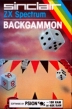
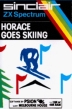

The classic “Horace goes Skiing” was already included in the bundle. PSION’s chess variant was very well received in 1983 and became the precursor to both the PC and Series 3 versions.
At the same time, however, an integrated business software suite for IBM compatible PC’s was developed, which would later be named “PC-Four”. By a strange coincidence, PSION’s history became intertwined once again with that of Sinclair’s as the latter was looking for a company to develop business software for a
new device called the QL (Quantum Leap). PSION’s ‘Office’ suite was the first choice and the decision was made quickly.
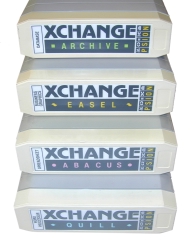
The project suffered somewhat from the chaotic development of the QL, and it was not a financial success,
PSION’s software and the documentation were highlights of the QL package.
A total of four programmes were developed: the flat-file database ARCHIVE, the word processing programme QUILL, the fully developed text-based spreadsheet ABACUS and the business graphics utility EASEL, not unlike the graphics section of EPOC Table. The applications could exchange data via intermediate files. The path to the ROM applications of the Series 3 and Series 5 is clear, and it is fascinating today to see PSION’s innovative spirit back then – years before the breakthrough of Office on the PC.
The entire development of the QL package ‘PC Four’ took place on a VAX minicomputer. These cabinet-shaped computers were very popular at the time and used the popular VMS multitasking operating system. The work on such a secure, well-structured and mature operating system clearly rubbed off on the PSION developers. The two operating systems SIBO and EPOC share some internal similarities with VMS and are renowned for their reliability.
PSION devices from 1984 to the present day
Below is an overview of all PSION organisers developed from 1984 to the present day.
The PSION Organiser
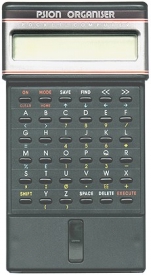
David Potter’s idea of a truly portable computer – one that didn’t rely on mains power and didn’t lose data when switched off, unlike the home computers of the time – was conceived, like so many other great products, in a London pub. The proverbial sketch on a napkin can also be seen, in the case of the Organiser, as the starting point for a sensational product. In the memorable year of 1984 – the year in which the Apple Macintosh and the IBM PCAT also saw the light of day – his vision became reality: the ‘PSION Organiser’ was offered for £ 99.
A rectangular case measuring 8 x 14 x 3 cm with an alphabetic key layout, a sturdy protective case, 2 kB RAM, 4 kB ROM containing the applications and an optional 8 KB data pack, which still had to be erased with UV light, that was all. The output appeared on a single-line LCD. However, the battery life was stated as an impressive six months(!) on a single 9V battery.
The software was little more than a clock and a flat-file database for information you wanted to keep – a feature that any credit card organiser for €10 offers. However, the basic functions could be expanded with modules: mathematical and financial software and the POPL programming language (PSION Organiser Programming Language). The most compelling selling point, however, was its proverbial robustness.
Thanks to very few moving parts and the robust casing, some devices are still in use today – after 40 years of use. Not many (pocket) computers of the current generation can be expected to do so.
Organizer II
The original idea behind the Organizer was brilliant, but there were, of course, demands for hardware and software upgrades. Thus, in 1986, the Organiser Mark II saw the light of day – with more memory, a higher resolution screen and an even better design. It was also the first time the now-famous PSION logo with the segmented letters is used. During a decade, no fewer than 500,000 units of the Organizer II were sold.
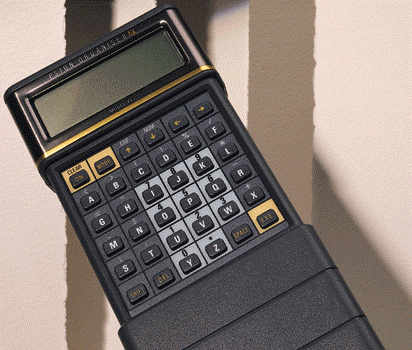
Over the next three years, continuously improved versions were developed. With the designations CM, XP, LZ, screen sizes ranging from one to two (CM, XP) to four lines (LZ) and memory sizes ranging from 8 kB to 64 kB, these variants enabled PSION to supply more software and allowed users to store even more information. And thus they rightly earned the name PDA – Personal Digital Assistant. For the XP, spreadsheet and word processing software (WordScribe) from third-party manufacturers were even made available.
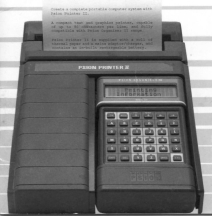
In addition to the two DataPak slots for memory and software expansion, a connector at the top of the device, which was particularly popular for the power supply, as a voltage of 21 volts is required when writing to the Datapaks had to be installed. But also the serial cable (with power connection), a Barcode reader, a telephone dialler and, last but not least, the connection to the PSION Printer II (see illustration on the reverse) were all accommodated there. Above all, this expandability and its virtually legendary robustness made the Organizer II very popular in the industry.
The concept was then continued in the HC and later in the Workabout, although all these industrial product lines are still available (in the UK).
MC 200/400/600/WORD
In 1989, a groundbreaking device in the form of the A4-sized MC 400 was introduced. It was ahead of its time in many respects. Firstly, SIBO, a new multitasking operating system with a graphical user interface. At that time, Microsoft’s graphical user interface, Windows, was in version 2.1 and still a DOS-enhancement.
A touchpad, which was absolutely innovative at the time, served as the cursor control. The keyboard had full-size keys, and the reflective super-twisted LC display was another outstanding feature. 256 kB of internal RAM and no less than four flash expansion slots offered vast upgrade potential, whilst even the proprietary SSD cards were sold at a high price. However, the SSD cards used back then are still, after more than a decade, fully compatible with the Series 3mx and the Workabout mx! Even back then, the hardware and operating system allowed for hot swapping of memory cards, something that wasn’t possible on laptops until much later with the PCMCIA standard.
Two expansion slots at the rear of the MCs were intended to accommodate accessories such as modems, fax machines, barcode readers and card readers, as well as a voice compression module, without the need for additional cables and without increasing the size of the machine. However, nothing more than the serial/parallel interface appeared on the market.
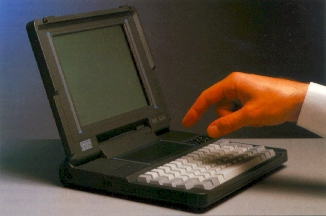
The power supply was also remarkably flexible. The battery slot could hold a rechargeable battery pack or a battery holder for no fewer than 8 AA cells (AA), resulting in running times of several hours.
The built-in software included Word, Diary, Calculator and Database, and was intended primarily to appeal to businesspeople and journalists. The price alone was set at a level for the professional market; at £ 845, the MC 400 was too expensive for the consumer market but actually cheaper than PCs. However, the press repeatedly criticised it for its lack of compatibility with PCs.
PSION responded to this – perhaps a little hastily – and launched the MC 600. Essentially an MC 400 with 640 kB RAM, an internal RAM disk of 1 MB and 256 kB of flash ROM, running MS-DOS 3.22. This almost doubled the price. The machine was a failure from the outset, not least because PC software still had to make do with CGA graphics of 640×240 (or 320×240) pixels, whereas SIBO, with 640×400 pixels, allowed for a high-resolution display of the GUI (Graphical User Interface).
However, PSION may well have brought about its own downfall. Not only because of sluggish sales, but also due to hardware issues with voice compression, which was not introduced until the Series 3, which was offered in 1993. Professional developers were only supplied with the SDK (Software Development Kit) after a year, and amateur programmers were frustrated because the included OPL version was very restrictive and programming in the look and feel of the internal applications was not allowed.
It was not until 1990 that version 2 of SIBO, which resolved some of the issues, was made available as a free update. SIBO was continuously developed. Initially, a Microsoft Word-like word processor, which arrived a few months later as a system update for the MC 400, changing the device name to MC WORD. Furthermore, OPL was expanded to include graphics and menu functions, enabling home users to develop applications in a simple language, that could compete with professional applications programmed in C. Not lastly, this also ensured a consistent PSION GUI, something that Apple also achieved with its strict ROMs and GUI guidelines, though, but which came much later and was adhered to less strictly.
HC
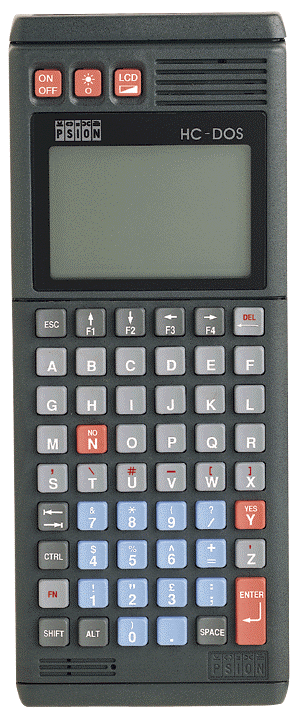
In parallel with the MC 600, the Organiser was further developed into the HC, i.e. with its own version of DOS on flash. Designed specifically for industrial applications, with the usual extensions for scanning and data logging etc., the HC was nevertheless not credited with any great success.
This also marked the end of the use of the Microsoft operating system DOS on PSION devices; only a small part remains included to this day. The flash drives are still formatted and written to using the MS Flash File System, which not least facilitates the easy interchangeability of Compact media with today’s digital cameras!
Series 3
September 1991 saw the official launch of the most successful PSION product to date – the Series 3. Everything was done right here.
The ingenious clamshell mechanism – the design that protects the screen, application keys and keyboard, the enhanced SIBO with the integration of Word and the diary, the enhanced successor to the MC Diary. The price was set just right (at £199 for the 128 kB RAM and £249 for 256 kB RAM). Only the lead-up time following the launch until it was fully available on the market was a little long. However, the Series 3 a resounding success, reflected in more than 100,000 units.
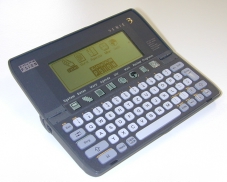
Unfortunately, it took almost a year for the SDK to be ready here too, however, with OPL/G, the graphical extension of the built-in programming, the starting signal was given for a flood of shareware and freeware, which contributed significantly to the success of the device and all its successors.
This success also contributed to a significant reduction in the price of the MC range, which was now available for £395 until the end of its product life.
Series 3a
Although the only slightly altered designation ‘3a’ might have suggested otherwise, the progress brought about by the Series 3a was immense. The screen resolution, now doubled in both directions to 480×160 pixels, the twice as fast NEC V30H processor running at 7.68 MHz, and the table app and digital sound, would have prompted a different reaction from many other companies. But perhaps this is simply an expression of the British understatement.
Despite the initially rather high price of £329 for the version with 512 kB RAM (alongside the 256 kB entry-level version), the Series 3a was a huge sales success, that was to last for three years. Following the somewhat crude pixelated graphics of the Series 3, the shareware market now literally exploded, with 1,500 applications, including numerous games. A figure that no other computer had ever achieved.
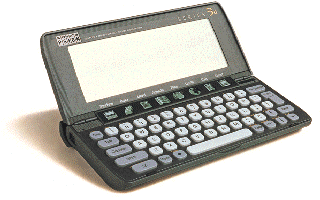
Over the next five years, only minor model modifications were introduced, without significantly altering the overall package. A 1 MB and a 2 MB versions represented the maximum capacity of the S3a.
Series 3c
The version upgrade to the Series 3c in 1996 introduced, for the first time, an infrared port (which, unfortunately, was not designed to be IrDA-compatible), a serial port three times as faster serial port (at 57 kbit/s) and, in terms of new software, Notes (Jotter), the File Manager (File) and the invaluable appointment overview in the Agenda.
The switchable backlight, initially available only on the American market, was only added to Newsgroups and online forums following protests from the European market newsgroups and online forums. The philosophy of low battery consumption, combined with the almost legendary battery life of up to 60 hours on two alkaline batteries was prioritised over technological innovation. A move by PSION that it would later repeat as the market trend shifted towards colour screens.
The Series 3mx, a late-generation high-performance model, was finally introduced in 1998; its main advancement was the NEC V30MX processor running at 27.68 MHz, which made it the undisputed ‘fastest XT’ of all time. This model is its sleek design, velvety-smooth and robust finish, and performance combined with the streamlined 16-bit operating system. Not least because features such as RTF import and export in subsequent versions of Word are still missing until today. The S3mx was replaced – although this was never officially acknowledged – by the revo, which, with the same screen resolution, offered the modern EPOC Release 5 (ER5) of the Series 5mx, with its advantages for mobile communication.
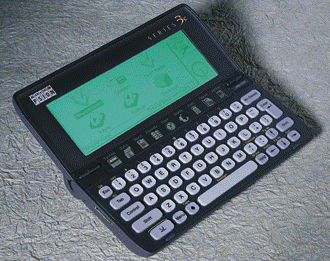
The Series 3 (classic, a, c, mx) thus became PSION’s ‘Beetle’, with over 1.5 million Series 3 units sold worldwide.
Workabout
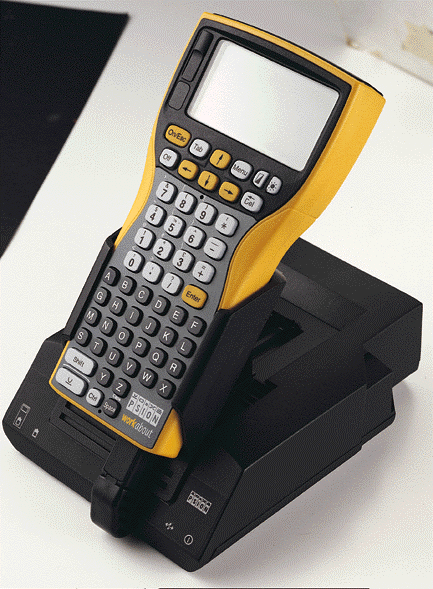
The redesign of the industry organiser concept, the robust Workabout, is the perfect workhorse for warehouse or field use. The built-in subset of the SIBO applications and the incredible range of options like barcode readers, scanners, printers and docking, charging and synchronisation stations made the Workabout a success despite its price. In private hands such a device rarely found its way; it was only collectors such as the author of this chapter brought wind in the Workabout second-hand market. One example of the operating system’s backward compatibility is the seamless execution of original Series 3 games such as Alien Swarm on the small screen of the Workabout, which was really not designed for that.
Siena
SIBO applications
In 1996, PSION launched the Siena, an attempt to open up a new market. Smaller, lighter, with the half the screen size of the Series 3a/c, the Siena had most of the features on board. It was aimed at people who were less interested in a universal pocket computer than a pure organiser for storing telephone numbers and appointments. The starting price was once again a bit on the high side, and the keyboard was slightly less sturdy than on the Series 3. Not at last, the Siena suffered from its two-part clamshell mechanism, which many people didn’t understand and which creaked when opened. The Siena was available in 512 kB and 1 MB versions. It was gradually phased out of the market and found with Revo a worthy successor that expanded the organiser’s target audience to include the Internet community.
Series 3mx
The last PSION consumer model, which features the 16-bit SIBO (Sixteen Bit Organiser) operating system was the Series 3mx, released in 1998. It has a robust matt grey metal finish, 2 MB of RAM, and the already three times faster V30 processor and a serial port with a speed of 115 kbit/s. Shortly after the launch of the Revo, the Series 3 range was finally discontinued, the only devices with SIBO are the current Workabout mx. New features of the operating system include the switch for the speed brake at 3a/c level, as well as the graphical view and the cut function in the Sounds application. The speed of the 3mx can fully keep up with later devices, thanks to the streamlined operating system.
Series 5
1997 marked the beginning of a new era for PSION and its customers. With the launch of the Series 5 on 16 June in London, everything changed. An ARM 710 RISC processor running at 18.43 MHz, 8 MB of RAM and the entirely new EPOC 32-bit multitasking operating system caught everyone’s attention. The screen now had half-VGA resolution (640×240 pixels) and was pressure-sensitive, meaning that with the stylus stored inside the device, one could perform ‘mouse actions’, i.e. clicking, dragging, pointing etc. Along the edge of the screen were screen-printed icons representing basic functions such as zoom or IrDA infrared transmission, and ROM software apps for direct access. The newly introduced CompactFlash slot finally brought storage expansion onto a standardised path, which now extends to over 200 MB and is compatible not only to digital cameras, MP3 players but is also PC Card-compatible with the help of an optional adapter.
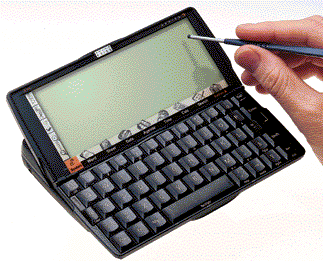
Long-standing PSION users soon criticised several compromises that the device and, unfortunately, the operating system had. Due to the backlighting and the touch panel, the screen appeared more grey-green than black and white, and the battery life was now ‘only’ 20 hours, in contrast to the Series 3, and there were repeated warranty claims regarding the rubber coating, which were, however, usually honoured without issue. The operating system opposite to the ingenious interface, which remained very similar to that of the Series 3, had to cope with a few restrictions. For instance, only a converter for data from the Series 3 to the Series 5 was provided, but not the other way round. The RTF capability of the word processor was dropped on the grounds that PC synchronisation of the new version of PsiWin connection software would provide sufficient PC compatibility.
The calendar lacked features such as an appointment overview and list view.
The spreadsheet could not sort data. New, however, was the ‘Web’ internet browser, which could be installed later, and the Message Suite (including mail and TCP/IP stack) from version 1.52 onwards.
Although the starting price of £499 was high, the device was so appealing that sales got off to a good start. The Series 5 won many awards for its excellent industrial design. The design sketches of the device, later published on www.psion.com under the code-name ‘Protea’ made this clear. The skipping of version number 4 was explained by the unpleasant connotations that the English number ‘four’ is said to have in Japanese and Chinese.
The ingenious clamshell mechanism of the Series 5, which allows one of the smallest full-size keyboards to slide out of the device, the storage of the stylus for the pressure-sensitive screen, and the slots for Compact Flash and backup battery, as well as the interface ports, recorder buttons and speaker, are truly ingeniously integrated into the casing.
Series 5mx / mx PRO
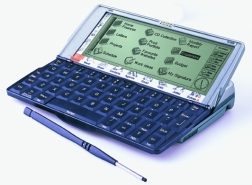
Almost exactly two years after the launch of the Series 5, the Series 5mx (codenamed ‘Snowdrop’) was unveiled. The main difference was the significantly improved ER5 operating system (EPOC Release 5).
Together with 16 MB of RAM, 8 MB of ROM instead of 6 MB, and a processor clock speed doubled to 36.864 MHz, this represented a very interesting further development of the Series 5 concept. For the first time, a Java Virtual Machine was included on the CD, which not only opened up new possibilities for web applications, but also
way towards cross-operating system Java applications.
Behind the new EPOC Release 5 operating system was, not least, a company called Symbian, founded in June 1998, which, alongside PSION Software (the inventors of EPOC), brought together the biggest rivals, but also competitors in the mobile phone market: Ericsson, Motorola and Nokia.
Since its foundation, Symbian has entered into a series of strategic partnerships with prominent companies in the telecommunications and information technology sector, including the world’s largest network operator NTT DoCoMo (Japan); Sun Microsystems; Oracle and Sybase. Matsushita (Panasonic) joined the Symbian joint venture in May 1999. Symbian currently employs around 650 people at 11 locations worldwide. Its licensees include such well-known companies as Philips, Sony, Kenwood and Sanyo, and most recently (since February 2001) Siemens.

The Series 5’s often-criticised screen has been made slightly richer in contrast, the backlight is quieter, slightly bluer and 50% more battery-saving. The package now finally includes both AA batteries and the lithium button cell, so that you can start using the new device immediately after unpacking – a thrill that the Americans aptly describe as OOBE – Out-of-the-Box Experience.
The surface has a metallic silver lacquer finish and is significantly more scratch-resistant than the rubber coating on the Series 5. The keyboard is now black; the euro symbol can be accessed via +. On the function keys at bottom of the screen, Data, Sketch and Clock have been replaced by Contacts, Mail and Notes.
The ER5 operating system has been significantly improved. Virtually every well-known app has been brought back up to its previous high standard; for example, the agenda’s appointment overview and sorting in the spreadsheet and the Outliner in Word have been restored; the system now includes the ‘Recently Opened Files’ and ‘Search’ have been added to the system, also ‘Notes’ made a reappearance. A new feature is the ‘Contacts’ application, an address database intended to replace the more general “Address” database. The underlying Netscape vCard standard allows not only easier synchronisation with organisers, but also direct data exchange via infrared, even with devices of a different type such as Palms or mobile phones. A similar capability has been achieved in Agenda for appointments. ‘Email’ is now included in the ROM and supports folders and the sending of SMS messages; the fax option includes a cover-page editor. The ‘Web’ browser is not included in the ROM to allow for a more flexible response to new standards, but in this version 2.0 it supports Java, frames and cookies.
The 5mx PRO series model was launched for the German market, with a distinctive feature: The so-called RAM-Only design keeps the entire operating system in a protected area of the RAM, which had been expanded to 24 MB. Later, the RAM was even expanded to 32 MB, which was already been announced by a label on the underside of the keyboard. Upon a cold start of the machine, the ROM image must be loaded either from a supplied 16 MB Compact Flash card or via a bootloader using a serial cable from the PC. This flexible system is intended for large-scale customer solutions that require a bespoke operating system. Naturally, this is also intended to facilitate operating system updates. But the risk of being left with a system that cannot be flashed without an operating system and without the option to transfer data to a PC exists (and naturally does not apply to the 5mx).
Series 7
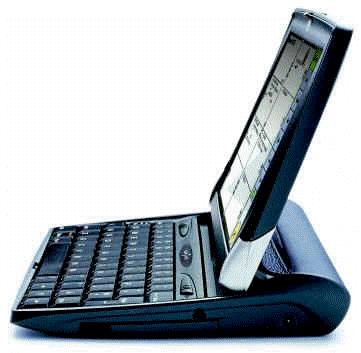
As early as September 1999, a device was released which, in line with the more open announcement policy of PSION Industrial had made a name for itself at CeBIT in March 1999. Initially marketed as the PSION netBook (prototype name ‘Jedi’), initially developed for the corporate market, a consumer version was launched ahead of schedule.
The so named Series 7 is based on the ER5, as is the 5mx/PRO series operating system, but in accordance with Symbian specifications, it was the first to adopt a full-VGA design with 256 colours. The device, which is larger than A5 and weighs approximately 1.1 kg, features a blue-grey leather cover, a solid, freely adjustable screen hinge mechanism, the best PDA keyboard to date and, last but not least, the large colour screen immediately catches the eye. Inside, for the first time, a 133 MHz StrongARM (initially only available at 100 MHz), which utilises 16 MB of RAM, which can be expanded to 32 MB. The focus on mobile internet is underlined by the
additional PC Card slot, which allows the use of modem cards, VGA cards and adapters for a second Compact Flash card. The Compact Flash slot now supports the Flash II specification. This makes it possible for the first time to use the 340 MB IBM MicroDrive (and, since summer 2000, the 1 GB version) and thus to increase the storage capacity of a handheld to unprecedented levels.
Due to the higher power consumption of the 7.7-inch STN colour screen, another first for PSION – a 10.5 V lithium-ion battery, which allows for a runtime of approximately 10 hours and is loaded in the netBook. A lithium button cell also serves as a memory backup battery. The touchscreen allows EPOC Release 5 to be experienced in colour for the first time, which could already be simulated somewhat earlier on the freely available ER5 emulator running on Microsoft Windows.
The speed of the Series 7 is barely higher than that of the Series 5mx, which is partly due to the different machine code of the StrongARM processor.
With a starting price of £700 and initially available only in the UK, the Series 7 was well received by the market. In some cases, it can replace an organiser and a notebook, so the price is easily justified. During a certain time it was possible to order the (English-language) Series 7 via shop.psion.com with an European power adapter.
revo
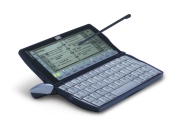
The design specifications for the revo must be quite the opposite of those for the Series 7. Take the base of the Series 5mx, make it only half as heavy, reduce the external dimensions just enough to keep a keyboard with properly keycaps. The screen reverts to the specifications – i.e. 480×160 pixels. The batteries are replaced by smaller rechargeable cells, the dictaphone buttons and the Compact Flash slot are omitted entirely. The result was the PSION revo – the ‘Connected Organiser’ as marketing called it.
Although the new screen is smaller and not backlit, thanks to a new reflective film from 3M, it is particularly high-contrast and easy to read. Although the keyboard has very flat keycaps, it is based on a foil keyboard and therefore has virtually no key travel. The clamshell mechanism – always a PSION speciality – is once again completely different, but once again ingenious. The soft, almost organic shape is very attractive and pocket-friendly – in closed and open state. For the first time production was moved outside England – to Taiwan – but this does not seem to have affected its robustness.
EPOC Release 5 in the revo has been reduced by ‘Fax’, ‘Sketch’, ‘Programme’ (OPL), ‘Comms’ and ‘Spelling’, though it has been enhanced to include the ‘Today’ view in ‘System’ and the new ‘Phone Manager’. As a game, ‘Cascade’ (formerly ‘SameGame’) replaced the game ‘Bombs’ in the 5mx.
However, the most important missing applications can now be downloaded from Psion (OPL) or from Epoczone.com (Sketch, Fax).
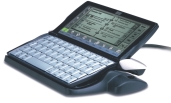
Included in the package are a docking station for connection to the PC and a – unfortunately very heavy – mains adapter for charging the NiMH battery. The backup battery has been omitted; the battery warning and subsequent shutdown of the Revo allow two weeks before recharging (only thereafter is a risk of data loss). With its lower price, stylish appearance, aggressive marketing and its focus on ‘Connected Organiser’ – the target group is a predominantly young clientele who plan their lives via mobile phone, the internet and organisers, and who have little need for a portable computer with countless uses. Its size comparable to the Palm, its design and built-in keyboard certainly make the revo a serious alternative for anyone who does not want to use a stylus-based organiser with handwriting recognition, such as Palm devices or Windows CE/Pocket PCs.
The commercial success of the revo, launched in September 1999, certainly proves this concept right. Within PSION’s ER5 family of devices (revo, 5mx/PRO, Series 7 / netBook), it is by far the most commonly sold through retail – at a launch price of 500 euros.
netBook
The English-language netBook was released around the same time as the Series 7 and is also available in a developer version with a PSION DACOM modem card, docking station, SDK and a few other extras. The specifications included a 190 MHz StrongARM processor, 32 MB of RAM (expandable to 64 MB), the black leather cover and the RAM-only design, as with the Series 5mx PRO.
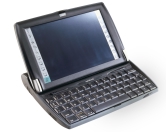
The promised Ethernet support for EPOC ER5 in the netBook (not available in the Serie 7!) is still in the alpha stage, which suggests difficulties in the imminent implementation of network protocols.
Although the German nationalisation of the netBook took until May 2000, but proved particularly popular among PSION fans, despite the price of €1,500. Evidently, the advantages of colour and screen size, instant-on capability and the higher processor performance were prioritised over the compromises in portability.
revo PLUS
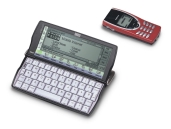
On 5 September 2000, PSION Germany unveiled the revo PLUS in Munich. It is essentially essentially a revo with 16 MB and an anthracite-grey casing. The included CD-ROM includes the registered version 3.62 of the Opera web browser and the PSION WAP browser – unfortunately not in the ROM, as many had expected. Otherwise, all specifications are the same as for the revo; the starting price of the revo PLUS is 500 euros, whilst the list price of the revo has simultaneously reduced to 400 €.
In the USA, the revo was launched as the SonicBlue mako (formerly Diamond mako) with the aim of further tapping into the American organiser market for EPOC devices.
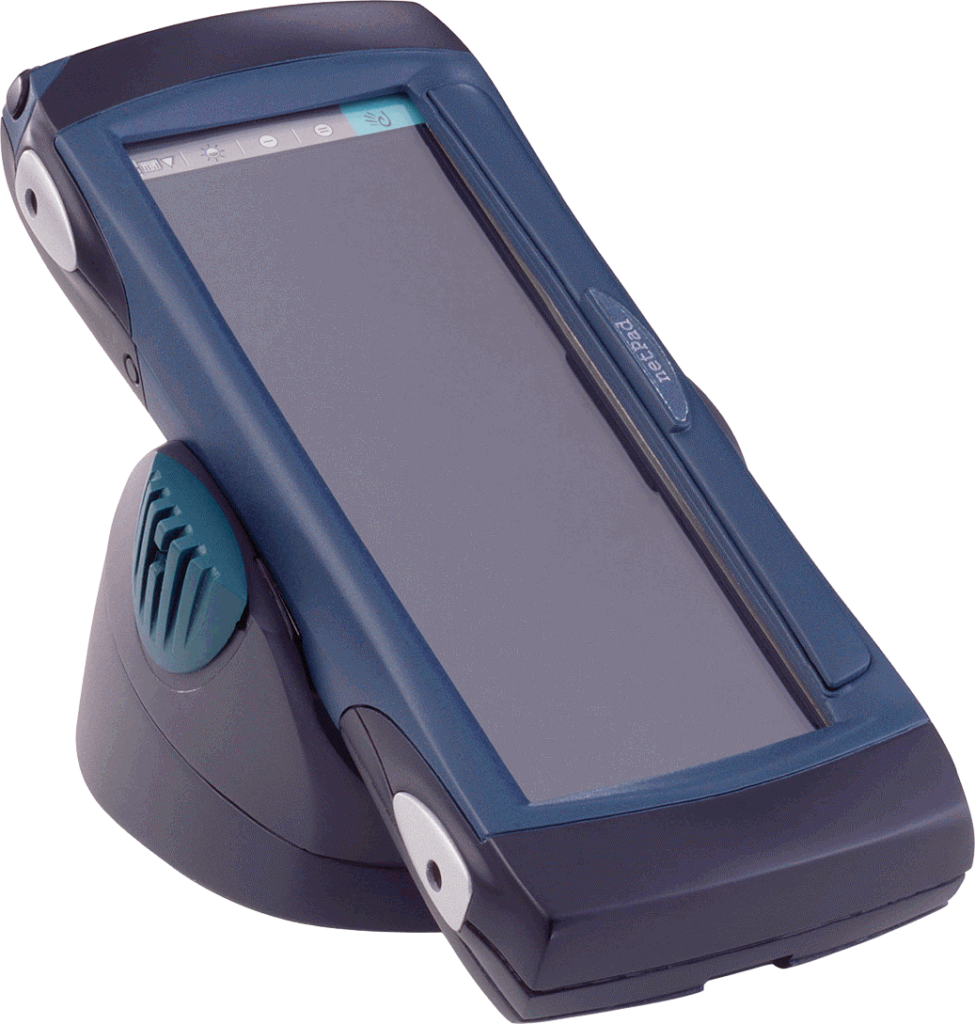
netPad
The netPad has been listed on the PSION USA website since CeBIT 2000 with a release date in the second half of 2000 but has not yet hit the market.
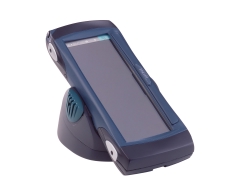
The netPad is a tablet-shaped industrial device with EPOC Release 6 (ER5 on the prototype), pure stylus operation with handwriting and a half-VGA colour screen. It is available in an encapsulated version that can withstand drops from a height of 1.5 m onto concrete and 30 seconds submersion in water.
The hardware is once again based on the StrongARM, this time running at 200 MHz, which Memory is specified as up to 64 MB of RAM. Another new feature is the switch to MMC memory cards. Despite the device being enclosed, it still features a speaker and a microphone. The IrDA port is now certified for speeds of up to 4 Mbit/s. Accessories for GSM mobile networks, barcode scanners and laser scanners will be introduced gradually.
The netPad is known in this form as the ‘Quantum’ prototype and is likely to replace the Workabout mx. The year 2001 is still vaguely cited as the publication date.
PSION 618C, 618S
In June 2001, PSION entered the organiser market in China, Hong Kong and Taiwan. Together with Synnex Technology, the company is launching a device based on the revo, featuring 8 MB RAM and 16 MB ROM, as well as the EPOC Release 5 operating system. There will be two versions: Simplified and Traditional Chinese, 618S and 618C respectively. For Taiwan and Hong Kong, the Traditional version will be offered with five input methods; for mainland China, the Simplified version with three – but both with handwriting recognition!
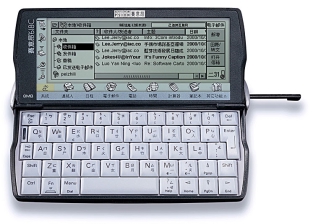
Psion Asia Pacific anticipates the region’s largest growth market, with 75% growth per year and a market volume of 3 million units in the year 2000.
In addition to over 13,000 built-in Chinese characters, the 618C features a Chinese-English/English-Chinese dictionary with intelligent word mapping and learning dictionaries for faster input. The PSION 618C supports Chinese SMS and comes with PsionLink for backup, restore and software installation.
The 618C is distributed from Taiwan and Hong Kong at a starting price of US$360.
Symbian reference designs and EPOC v6 devices
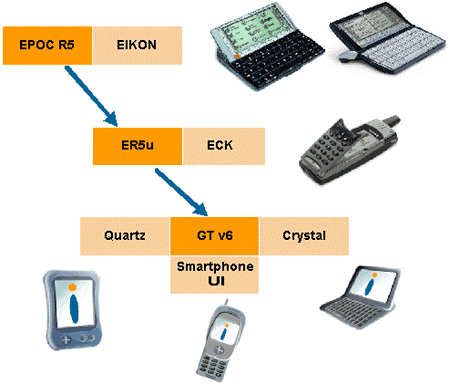
Since the end of 2000, smartphones and communicators with various versions of the EPOC operating system have been on the rise. Initially, Symbian introduced reference designs under the code names Crystal, Quartz and Pearl by Symbian, partners and licensees can now incorporate this expertise into their own products and market them.
No fewer than 20 of these devices running the EPOC operating system. However, the market readiness of these devices and that of EPOC 6.1 with GPRS support has been delayed, as has the widespread introduction of the GPRS standard for mobile internet. Symbian now refers to EPOC Release 6 as GT v6 – Generic Technology Version 6.1 for 2.5G – that is, for the 2.5th generation of mobile communications, or GPRS. (Note: The subsequent UMTS then corresponds to 3G, the third generation)
Ericsson R380s
Ericsson kicked off the new generation of Symbian devices in November 2000 with the R380s smartphone. On the outside, it looked like a normal, perhaps slightly large, conservative-looking mobile phone.
Once opened, the keyboard flap reveals an organiser with a crisp black-and-white screen in landscape format! With a resolution of 320 x 120 pixels, it offers a small but fine selection of organiser features, which, however, cannot be used without the mobile phone function – for example on aeroplanes.
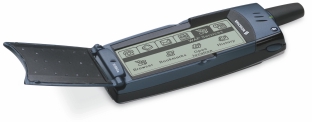

The operating system is EPOC R5u – EPOC Release 5 with Unicode support – with 2 MB of non-expandable RAM. The software features WAP, SMS, e-mail, calendar, contacts, calculator, alarm and a game – but is unfortunately not expandable with further apps. An integrated IrDA modem allows probably also to build bridges from PSION’s to the Internet. PC synchronisation – with MS Outlook, Lotus Organiser and Lotus Notes – is included.
Quartz
Quartz is the name given to the Palmtop reference design. The key specifications are a quarter-VGA display (320 x 240 pixels in colour – similar to Pocket PCs), stylus operation without a keyboard, plus a few additional buttons for cursor control and the Enter key.
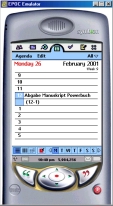
The software is centred around the main ‘Contacts’ application and offers a messaging application for email, SMS and fax. The phone software is provided by the respective handset manufacturer. The browsers support the HTML 3.2 and WAP 1.1 specifications. A calendar, to-do lists, a notepad supporting rich text and images, a calculator, a world clock with alarm, voice memos, a system environment called ‘Launcher’, synchronisation software and the ‘Control Panel’ round off the standard software package.
Software development is carried out in C++, Java and, according to conflicting reports, also in OPL. Whilst Quartz v6.0 already supports Bluetooth, v6.1 is the first version to include GPRS and WAP 1.2 support. Further services are planned in Symbian’s roadmap for version 6.2.
No new devices have yet been announced, not least because the PSION-Motorola development partnership broke down in February 2001. However, at CeBIT 2001, Ericsson demonstrated a GSM-compatible prototype of a Communicator – based on the Quartz reference design – though without specifying a release date. Sanyo, too, had already showcased a working prototype at a Japanese high-tech trade fair.
Crystal
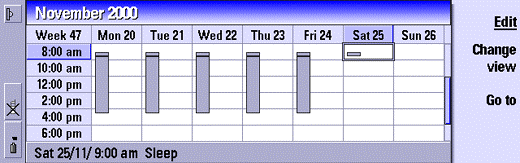
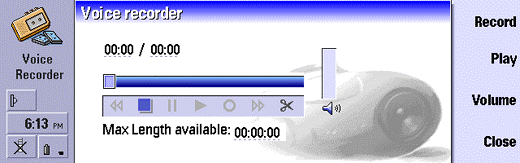
Crystal is the Symbian reference design for keyboard-based Communicator devices. With a resolution of 640 x 200 pixels in colour or black and white, and a keyboard, stylus and function -key interfaces, it can accommodate many different usage scenarios. Due to the keyboard operation, this device class is naturally better suited for
emails, word processing and spreadsheets than the Quartz design. EPOC Word and Spreadsheet are supported, and a PowerPoint viewer is new to the software package. File conversion is now possible on board.
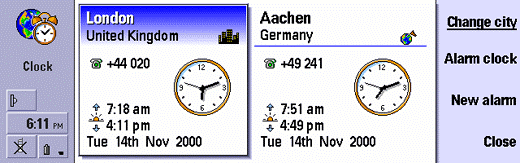
The function keys are on the right-hand side, whilst the status bar is on the left-hand side of the screen.
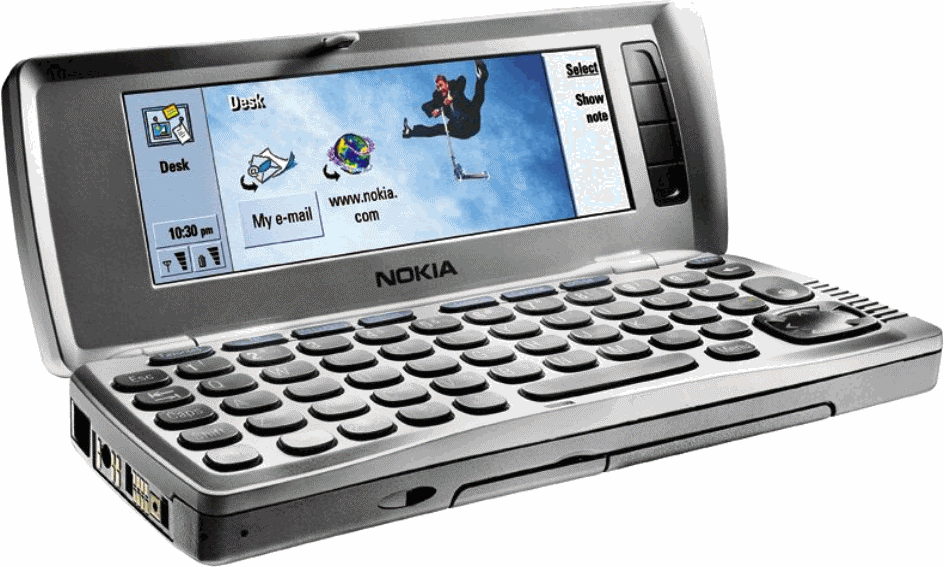
Nokia 9210
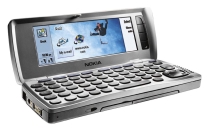
The successor to the well-known GEOS-based Nokia 9110 Communicator now runs on the Symbian v6.0 platform with a manufacturer-specific user interface. Unveiled on 21 November 2000, it has been available since the second quarter of 2001.
Tailored for mobile internet users, the Nokia 9210 offers WAP and HTML browsers, email and SMS, as well as a wide range of organiser, synchronisation and connectivity features. Communication with digital cameras, other mobile phones and organisers is also supported via IrDA and the vcf-standard.
Mobile phones and organisers are also supported via IrDA, or the vcf
standard.
Pearl – the SRD smartphone
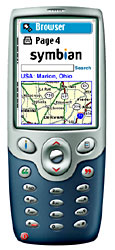
Pearl is the SRD (Symbian reference design) for smartphones running GT6. Smartphones are defined by Symbian as voice-centric devices with information capabilities, whereas communicators as information-centred devices with voice capabilities.
With colour screens ranging from 176 x 208 to 240 x 320 pixels, Pearl mobile phones are certainly among the larger devices. Emphasis was placed on both hardware and the operating system simple, one-handed operation. Text input is done via a stylus, although this feature is optional.
The supported communication standards include GSM, GPRS, HSCSD, infrared, Bluetooth, OBEX, serial, USB, TCP/IP, PC connectivity and security certificates. The messaging functions include email and SMS, each with access to contacts, POP 3, IMAP 4, SMTP, MIME, MHTML, WAP, and vCard v2.1 support via SMS/email/Bluetooth/IR.
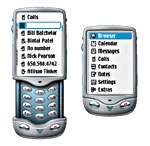
The flexible programming environment is intended to encourage the development of professional third-party applications: C++, Personal Java 3.01, Java Phone 1.01, WML (WAP).
At the time of going to press, no manufacturer is yet known to be offering a specific product based on the Pearl smartphone reference design.
PSION’s Concept Studies
At CeBIT 2001, PSION is showcasing two highly forward-looking design and concept studies, which we would like to share with interested readers.
ACE
When closed, the ACE bears a resemblance to a Minidisc player; only the digital camera lens stands out. When open, one can see no fewer than three wafer-thin, colour LCD displays, which can be used in combinations of one to three screens.
Add to that Bluetooth and GPRS with a headset, and it becomes clear that the PSION ACE is absolute high-end. A mini trackball serves as the input device, and docking station is provided for recharging the batteries. The operating system is Symbian’s EPOC.
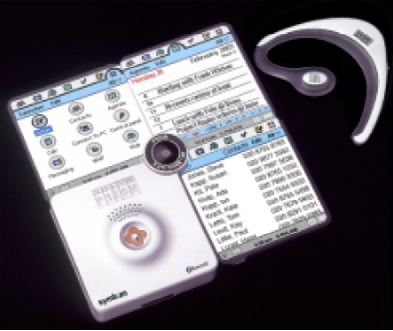
Outstanding design paired with innovative technology – a standard that PSION has always upheld. The combination of capabilities and size alone will likely require some patience from potential buyers.
HALO
HALO is perhaps even more futuristic than ACE. A glasses-like basic design, which is, however, open at the front and features small. It is nothing more than a PDA that projects its content onto any surfaces. Hence the name Micro Projection System. A forum post on Geek.com simply remarked laconically: ‘Jordi Laforge’s PDA’ (Note: from “Star Trek: The Next Generation”).
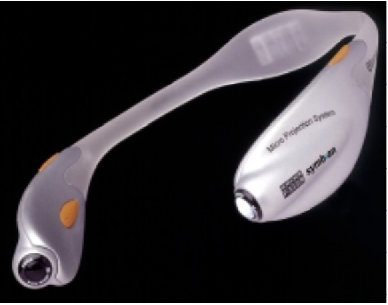
Why the projection is not directed onto the user’s retina, as some virtual reality glasses already do, is likely to remain a mystery for some time. As with ACE, the features include a digital camera, 3G mobile telephony and Bluetooth. Voice control serves as the input method – with the familiar issues in public spaces.
Market observers believe ACE has a better chance of success, although HALO has the greater high-tech appeal. In any case, both concepts differ drastically from anything seen so far at seen at trade fairs or in shops. The innovative drive of PSION’s concept developers and industrial designers remains undiminished.
PSION, Symbian and the Future
In the following, we examine the future development of PSION, Symbian and its licensees, as well as the devices currently available on the market and those expected in the near future.
PSION, the consumer market and 11 July 2001
On 11 July 2001, Psion shocked the industry with the announcement that it would not be developing any further organisers for the consumer market for the time being. Many wondered: Is this already the end? What does the future hold for Psion?
Following a number of clarifying press releases and interviews, it became clear that the consumer market had indeed been abandoned due to falling margins and the fragmentation of the market into countless products. In practice, this means that the current PSION Revo Plus and PSION Series 5mx and 5mx Pro devices will continue to be sold, with the latter even still being manufactured in the UK. Support will be guaranteed for at least another three years. However, there will be no further development (for the time being). The PSION netBook is being further developed as an industrial device by Psion Teklogix. The PSION DACOM Bluetooth product line is being discontinued due to a negative market assessment. Products that had already been the subject of rumours, such as the so-called Bluetooth Revo with backlighting and built-in Bluetooth, as well as a much-rumoured Series 5 with StrongARM and a colour screen, remained in the developers’ drawers.
The future now bears the names Psion Teklogix, Symbian, Nokia, Sony Ericsson and Siemens. PSION is and remains the largest shareholder in Symbian and will certainly assert its influence and expertise regarding the Symbian OS. However, hardware development is more likely to come from the licensees, but that was the plan anyway, despite Symbian reference designs (Crystal, Quartz and Pearl).
PSION, Teklogix and the modifications
In addition to the Psion Series 5mx / PRO and revo / plus, which are available until further notice, Psion Teklogix markets the netBook and the netPad in several variants for the industrial sector. Just recently, Version 158 of the netBook operating system EPOC Release 5 was released. This release introduced Wi-Fi and LAN card support and the Opera browser 5.14 instead of EPOC Web 2.0. In any case, the netBook is currently being undergoing further development; a successor version will likely have to address the current issues of WLAN and PC Cards.
The netPad has been available for several months; with its exceptionally robust design, it is aimed at industrial applications such as shipment tracking, data collection by field service staff, meter reading and sales and delivery services. However, thanks to its exceptional robustness, however, the netPad is also of great interest to extreme sports enthusiasts, expedition participants and urban adventurers.
The interesting innovations in PSION hardware are the revo upgrades, which are currently offered by a number of companies and organisations: The memory upgrade to 24 MB was initiated by D & G Upgrades, a company founded by former Psion employees. A battery upgrade is also available. And perhaps even more interesting for many, is a switchable backlight for the revo screen. First the Korean Psion User Group on the web, it is likely to become available, following an auction on eBay, there are now likely to be successful trials in Germany in this direction.
Modifications to the 5mx with integrated automatic charging, or the Revo docking station to switch off continuous charging when in docked state round off the range of modifications.
Smartphones with Symbian OS 6.x
Products running Symbian OS 6.0 or 6.1 – i.e. smartphones – are still few and far between. The Nokia 9210 Communicator alone has been on the market since June 2001, and since June 2002, its successor, the 9210i, has also been available with more main memory, Opera browser, Real Player and Flash MX Player. With the announced GPS module and the well-known TomTom CityMaps navigation software (formerly StreetPlanner), another key feature will be available on the smartphone, which many already appreciate from revo, Series 5 or netBook. The direct successor to the Communicator with GPRS is only the subject of rumours; the subsequent device, codenamed Hilden or 9510 is even further off.
Smartphones with Symbian OS 7.0 and UIQ
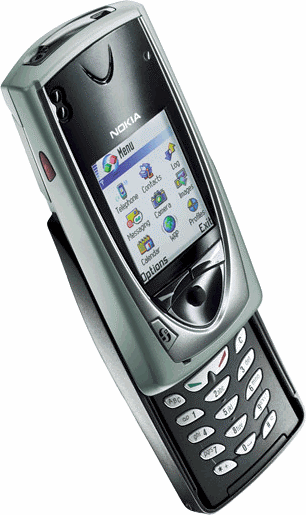
The two most tangible future models – after all, working for some time, and their market launch has been officially – are the Nokia 7650 and the Sony Ericsson P800. Both open up the category of imaging phones or multimedia smartphones running Symbian OS 7.0 and the new UIQ user interface.
The Nokia 7650, announced in November 2001 in Barcelona by Nokia CEO Jorma Ollila as Nokia’s first imaging smartphone, heralded a phase of openness for Nokia and Symbian. With Nokia’s Series 60 platform – a complete mobile phone platform with Symbian OS – mobile phone manufacturers and Telecom providers can quickly and efficiently offer their own models. This means for the Symbian operating system to reach critical mass more quickly and become the standard.
But back to the Nokia 7650: with GPRS and MMS (Multimedia Messaging Service), it is the first 2.5G Symbian smartphone. The built-in camera can be used for both snapshots and portraits for the picture phonebook and for MMS. The colour display has 4,096 colours at 176 x 208 pixels also serves as a viewfinder for the VGA digital camera integrated on the back. Navigation is done via a joystick, and Bluetooth and IRDA are on board. Communication can take place via MMS, WAP and email (using the SMTP, POP3 and IMAP4 standards).
“Real Internet” is not available. The 7650 is a dual-band mobile phone and supports HSCSD (43.2 kbps) and GPRS (40.2 kbps).
The Sony Ericsson P800 imaging smartphone with integrated digital camera runs Symbian OS 7.0 on an ARM 9 CPU and has 8 MB ROM and 12 MB of RAM. The launch of the globally compatible tri-band mobile phone is expected at the end of September 2002. It supports both HSCSD (28.8 kbps) and GPRS (4+1 slots, 53.6 kbps).
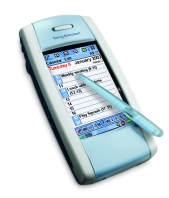
The P800 features a colour touchscreen with a resolution of 208 x 320 pixels and 4,096 colours. The fold-out keyboard is similar to that of the R380e but is fully removable.
Symbian OS 7.0 with a UIQ interface operated via stylus and jog dial enables Internet (HTML and xHTML), iMode and WAP. The operating system is open to applications programmed in C++ and Java (J2ME/MIDP).
Input can be via handwriting recognition, on-screen keyboard or keyboard. With Bluetooth, IrDA, USB and serial ports, all standard interfaces are supported. The ’communicam’ integrated on the rear can capture images with a resolution of 640 x 480 pixels in 26.7 million colours and save them in JPEG format. As with the Nokia 7650 the P800 supports video playback, not least to display Sony content. Synchronisation functions via SyncML with Microsoft Outlook and Lotus Notes are, of course, included. The built-in file viewers for Acrobat PDF, Word, Excel and PowerPoint allow viewing of email attachments even without a desktop PC.
The P800 presents itself as a well-rounded high-tech package. Opinions may differ on the bright aqua design, but the inclusion of the new Memory Stick Duo slot seems sensible, as it allows the 12 MB of RAM to be expanded by up to 128 MB – a capacity well suited to a multimedia phone.
Other Symbian licensees
And there are several other well-known Symbian licencees, foremost among them the latest partner, Siemens. Judging by their direct collaboration with Nokia on the Series 60 model and the current Java phones, we can expect Siemens to produce some very serious and high-performance devices.
It is still unclear which devices Motorola, Matsushita/Panasonic and Sanyo will be showcasing; only Sanyo has so far displayed a prototype model at trade fairs in Japan. The products from the Series 60 licence holders are also still a mystery; it remains to be seen whether standardisation will benefit the market.
All in all, two lines are emerging – the communicators and smartphones, which are taking on more and more organiser functions, and Psion Teklogix’s industrial devices, the netBook and netpad.
The classic keyboard organisers, the revo and Series 5, remain on the market; however, the further development of these PDAs awaits an investor to breathe new life into the PSION hardware division.