
To make a museum site about portable handheld computing and not mention Psion would be a massive mistake! Psion PLC was a British technology company whose influence on mobile computing far exceeded its eventual commercial success. Long before smartphones became mainstream, Psion developed handheld computers that combined serious productivity, sophisticated operating systems, and thoughtful industrial design. Founded in 1980, Psion’s story is one of early vision, technical excellence, and the difficulty of sustaining leadership in a rapidly changing market.
Founding and Early Vision

Psion was founded in London in 1980 by David Potter, a Cambridge-educated physicist with a Ph.D. in mathematical physics. Potter was not a typical consumer-electronics entrepreneur; his background lay in scientific research and systems thinking. This shaped Psion’s culture from the outset: engineering-driven, intellectually ambitious, and focused on long-term technological possibilities rather than short-term trends.
The company’s name originated from “Potter Scientific Instruments,” with “on” added to create a distinctive brand (some suggest that it stands for “Or Nothing”). Psion initially operated as a software house, producing games and applications for early British home computers such as the Sinclair ZX81 and ZX Spectrum. These early projects helped the company develop expertise in writing efficient software for highly constrained hardware — a skill that would later prove crucial.
From the beginning, Potter’s vision extended beyond desktop computing. He believed that computers would eventually become personal, portable tools, carried and used throughout the day rather than confined to an office or home desk. At a time when most computers were large, expensive, and stationary, this idea was both radical and unfashionable.
The Psion Organiser and the Birth of the PDA
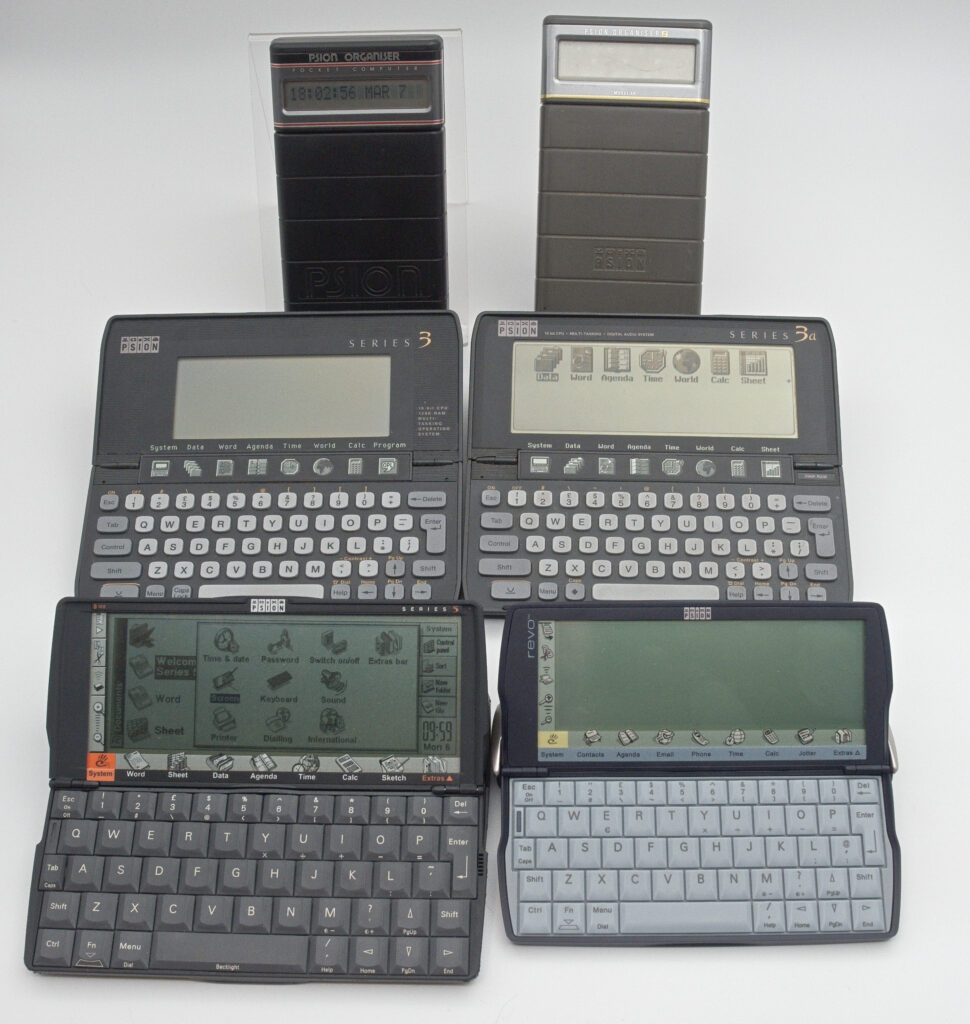
Psion’s defining breakthrough came in 1984 with the launch of the Psion Organiser. Often described as the world’s first mass-market handheld computer, the Organiser combined a small LCD screen, keyboard, removable storage, and built-in applications such as a database, calculator, and diary. While primitive by modern standards, it represented a genuine shift toward portable personal computing.
The Organiser II, introduced in 1986, expanded memory, improved usability, and broadened the appeal of the platform. It found success among professionals who valued portability — engineers, surveyors, and business users — rather than the general consumer market. Importantly, Psion did not position the Organiser as a toy or novelty, but as a serious productivity device.
This emphasis on usefulness rather than entertainment would remain a hallmark of Psion’s products.
Growth, Operating Systems, and Technical Leadership
During the late 1980s and 1990s, Psion invested heavily in software platforms. It developed its own operating systems, first SIBO and later EPOC, which offered multitasking, efficient memory management, and a flexible application framework. These systems were designed specifically for low-power, portable hardware — years ahead of mainstream desktop operating systems in this regard.
Psion’s Series 3 and later Series 5 palmtop computers became highly respected among enthusiasts and professionals. The Series 5, released in 1997, featured a sliding clamshell keyboard, a large touchscreen, and a refined user interface that many still regard as one of the best ever designed for a PDA.
Despite modest sales volumes compared to mass-market electronics, Psion had established itself as a technical leader in mobile computing.
Timeline of Key Events
- 1980 – Psion founded in London by David Potter
- Early 1980s – Software development for Sinclair home computers
- 1984 – Launch of the original Psion Organiser
- 1986 – Organiser II released, expanding functionality and adoption
- Early 1990s – Psion Series 3 palmtops gain popularity among professionals
- 1997 – Psion Series 5 introduced, showcasing advanced industrial design and OS maturity
- Late 1990s – Increasing competition from Palm and Microsoft-backed handhelds
- 2000 – Acquisition of Teklogix, signaling a shift toward industrial devices
- 2001 – Psion exits the consumer PDA market
- 2012 – Psion acquired by Motorola Solutions
Market Pressures and Strategic Retreat
By the late 1990s, the PDA market had become crowded and highly competitive. Palm devices emphasized simplicity and aggressive pricing, while Microsoft promoted Windows CE as a familiar platform for developers and enterprise customers. Psion’s products, though powerful, were relatively expensive and slower to evolve.
At the same time, mobile phones were rapidly absorbing functions once exclusive to PDAs. Synchronization, wireless communication, and later email access began to reshape user expectations. Psion’s cautious, engineering-driven approach struggled to keep pace with the accelerating consumer electronics cycle.
In 2001, Psion made the pivotal decision to withdraw from the consumer handheld market. This was not an abrupt collapse but a strategic retreat, acknowledging that the economics of consumer PDAs no longer aligned with the company’s strengths.
Enterprise Focus and Final Chapter
Psion’s acquisition of Teklogix allowed it to reposition itself as a supplier of rugged, industrial mobile computers used in logistics, warehousing, and field service. Under the Psion Teklogix name, the company continued to operate profitably, albeit far from the public eye.
In 2012, Psion’s long independent history came to an end when it was acquired by Motorola Solutions, which integrated Psion’s technology and expertise into its enterprise mobility division.
Legacy
Psion did not survive as a consumer brand, but its legacy is profound. It demonstrated that handheld computers could be powerful, practical, and well-designed long before smartphones made the idea mainstream. Its focus on operating systems, usability, and real-world productivity influenced later generations of mobile devices.
In many ways, Psion’s story is not one of failure, but of being early — and being right too soon.
Sources
- The history of Psion, by Steve Litchfield
- Psion Power Book (by Thomas Ullrich. First chapter of a book in German, translated to English here)
- Wikipedia: Psion (company)
- Company-Histories.com: Psion PLC Company History
- Centre for Computing History (UK): Psion product records and Organiser history
- A very long and interesting article about Psion in The Register 2007
- Psion the rise and fall of a pocket computer – Video at Youtube by Tech History Channel