
The machine that thinks with you (phrase from its brochure)
Quick facts
- CPU:
- Hitachi HD6303X @ 3.6864 MHz
- RAM (KB):
- 32
- Storage (MB):
- -
- Display:
- 2 lines of 16 characters (5x7 matrix)
- Operating system:
- No real OS
- Year introduced:
- 1986
- Power source:
- 9V battery
- Connectivity:
- Serial port
- Dimensions (mm):
- 142.0x78.0x29.3 mm
- Weight (g):
- 250
- Built-in apps:
- DATA, DIARY, CALC, TIME, ALARM, ...
- Input method:
- Keyboard
Overview
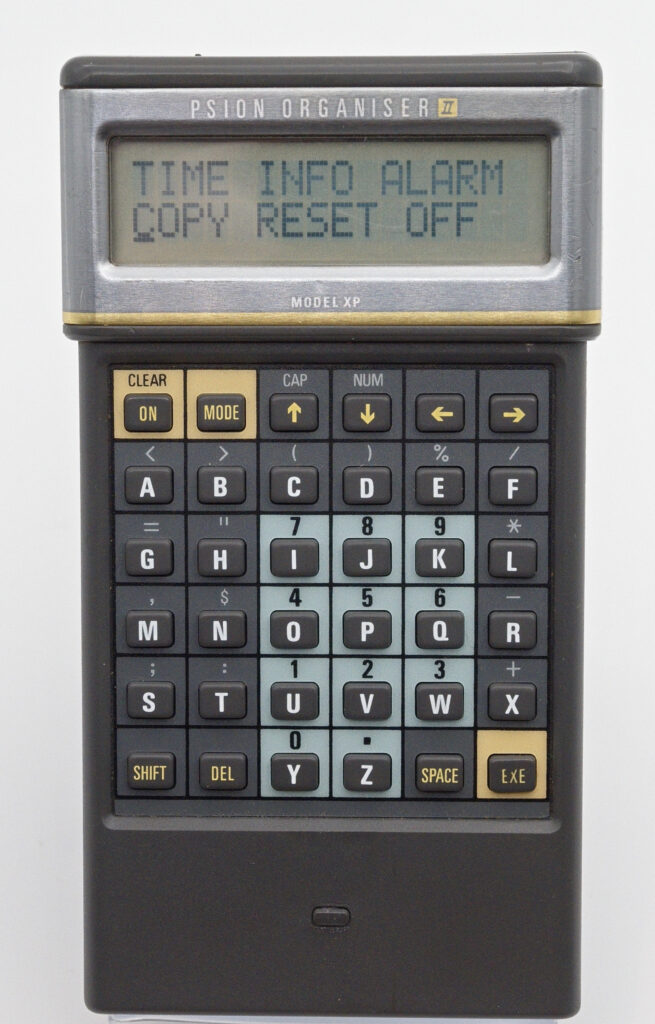
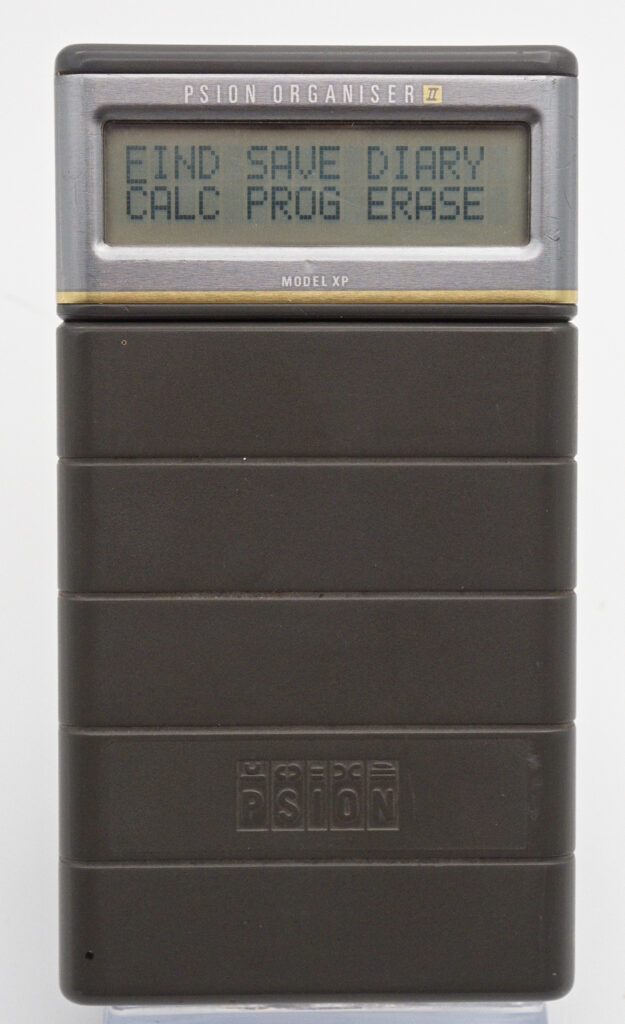
Building on the relative success of the original Psion Organiser, released two years earlier, Psion took the concept of a handheld computer a significant step further with the Organiser II. The most visible improvement was the display, which now featured two lines instead of just one. However, the real advancements were found beneath the surface.
The most important upgrade was the increase in available RAM. While the original Organiser had only 2 KB, the Organiser II started at 8 KB and was available in several configurations with significantly more memory. My unit is the XP (LA) model — where LA stands for Los Angeles, indicating its target market — and it comes equipped with 32 KB of RAM. Although this may seem tiny by today’s standards, it was a substantial improvement at the time and enabled developers to create a wide range of useful applications.
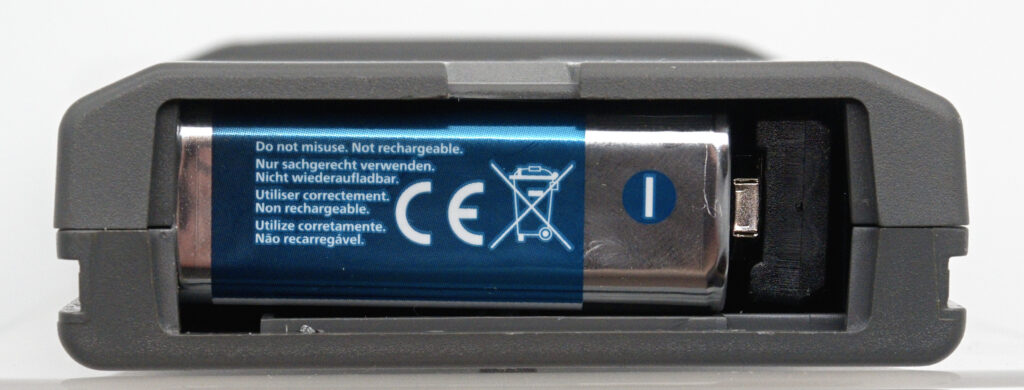
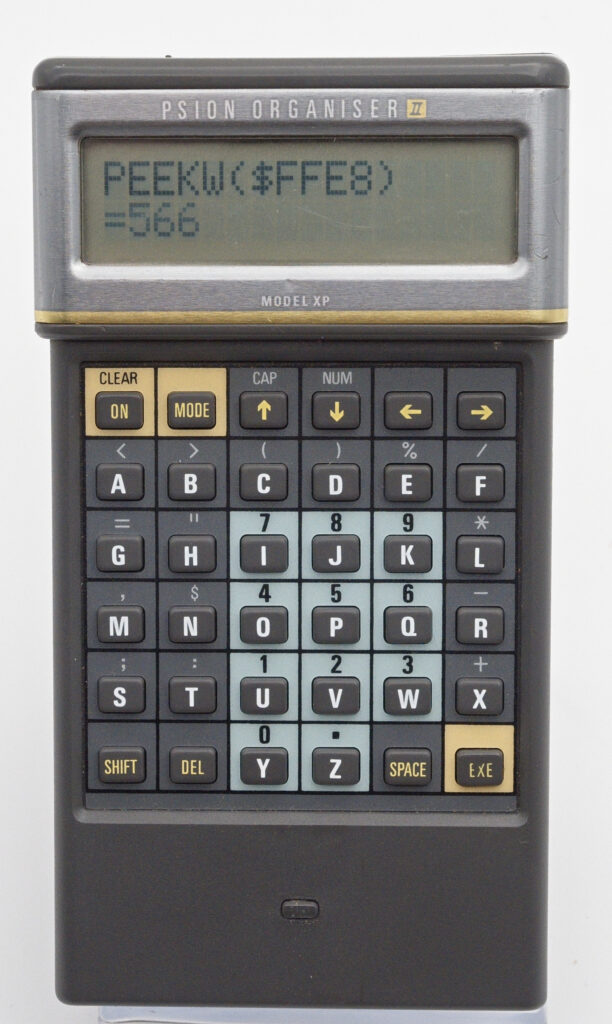
At the same time, many core aspects remained unchanged. The 64-key keyboard, arranged in alphabetical order, the characteristic sliding cover, and the dual expansion slots were all carried over. Like its predecessor, the Organiser II was powered by a single 9V battery.
Hardware
The Organiser II is powered by an 8-bit CMOS processor from Hitachi (HD6303X family). One of its key features is the ability to halt the clock entirely when idle, making the device extremely power-efficient and contributing to the long battery life.
Compared to the earlier Organiser, improvements included a higher clock speed — increased from approximately 0.9 MHz to 3.6864 MHz — as well as a larger ROM (8 KB instead of 4 KB). These changes provided more room for built-in functionality and improved overall performance.
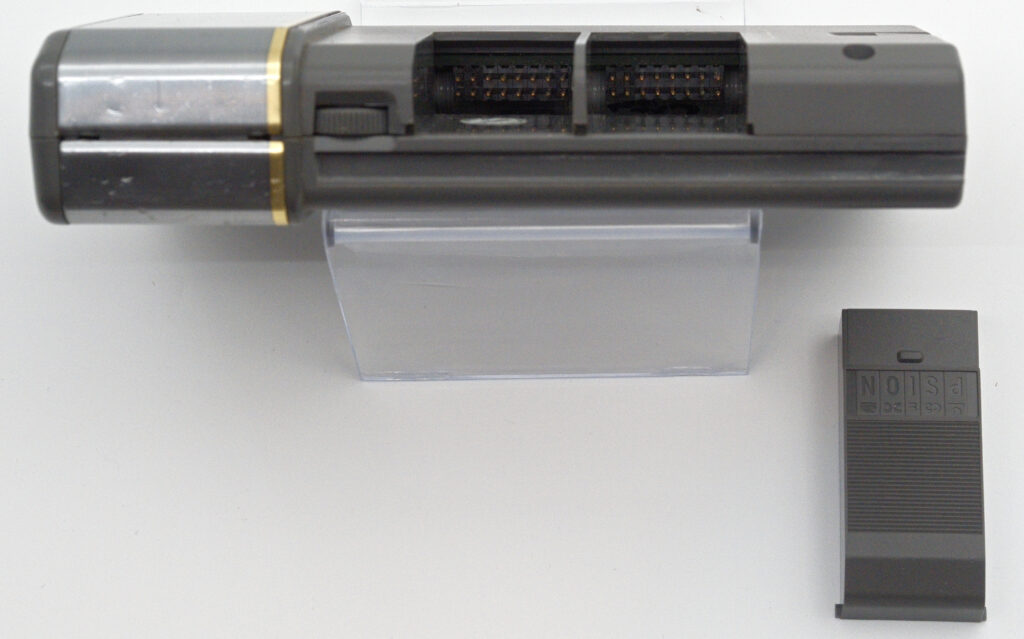
The Organiser II was produced in multiple variants with differing amounts of RAM, and it was also rebranded for large customers such as the BBC and Marks & Spencer. Despite these variations, all models shared the same expansion system: two slots for removable storage modules known as DATAPAKs.
These DATAPAKs came in several forms:
- Battery-backed RAM cartridges
- ROM cartridges containing software
- EPROM cartridges for user data storage
The EPROM DATAPAKs were particularly interesting. They were “write-once-read-many” devices — once written, they could not be modified unless erased using an external ultraviolet eraser. Later models introduced electrically erasable EAPROM cartridges, which could be rewritten directly in the device.
The memory model of the Organiser II was essentially sequential. Files could only be appended to, and reading always started from the beginning of the file. This design made both everyday use and software development more restrictive than one might expect.
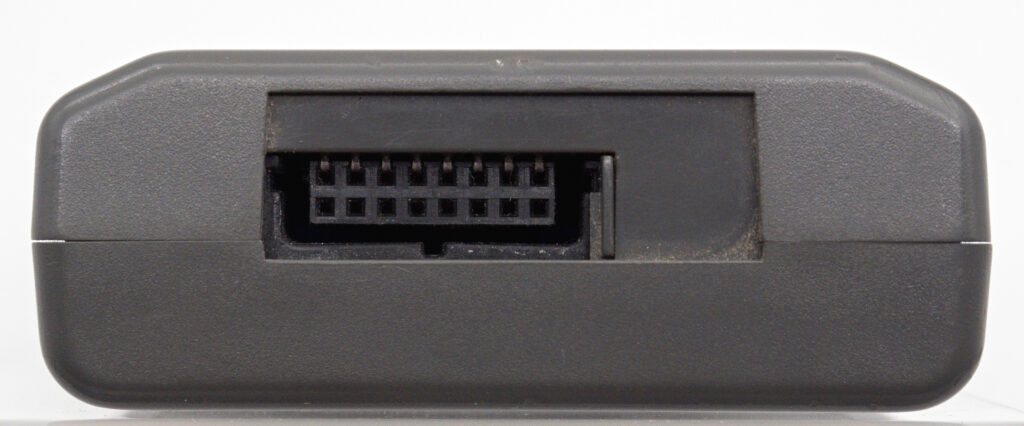
Concealed behind a sliding door at the top edge of the device was a connector that proved surprisingly versatile. Not only did it allow the Organiser to connect to a PC, it also enabled the development of a wide range of hardware add-ons.
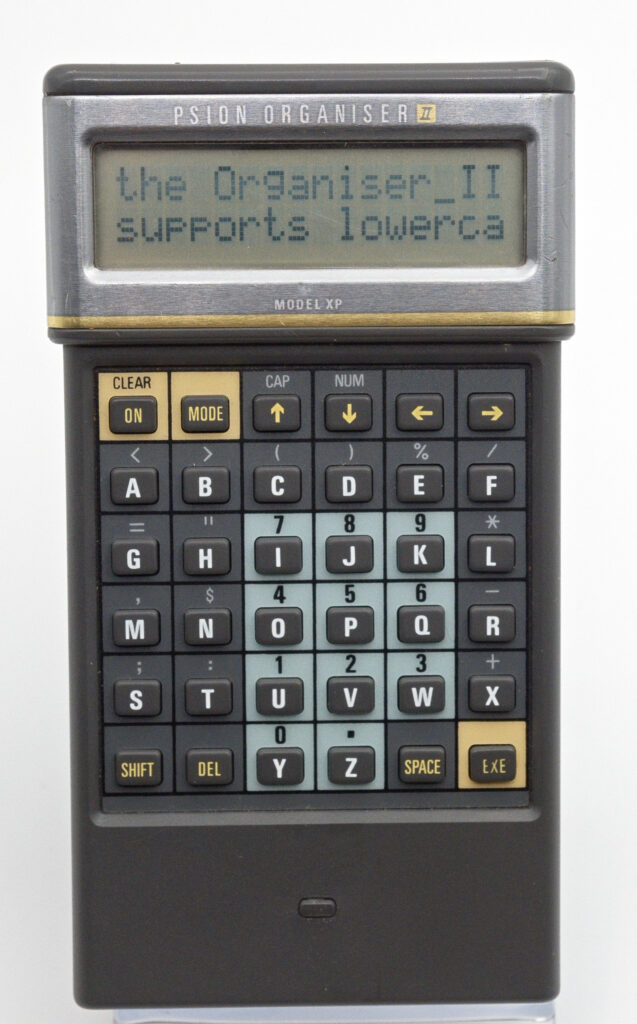
The display consisted of two lines of 16 characters, with each character rendered using a 5×7 dot matrix. It supported uppercase and lowercase letters, numbers, and a limited set of special characters. Contrast was adjustable via a small wheel on the side, and readability is excellent even today.
Remarkably, the Organiser II line remained in production for around ten years. Later models improved on the design by introducing four-line displays and addressing some of the limitations of the earlier versions.
Software
The Organiser II came with several built-in applications, including DATA, DIARY, CALC, TIME, and ALARM.
The DATA application was arguably the most versatile. It allowed users to store structured information such as addresses, phone numbers, to-do lists, or general notes. However, it was limited by the underlying memory model: data could only be appended, and each file was restricted to 16 lines of up to 254 characters.
The DIARY application offered basic scheduling functionality, somewhat similar to the Agenda applications found on later devices, although the two-line display limited its usability.
Where the Organiser II truly stands out is in its programmability. It includes a built-in BASIC-like language called OPL (Organiser Programming Language), which allowed users to write their own applications directly on the device. This capability was central to its success. Users requiring higher performance could choose to write software in assembly language. Psion’s own development environment was based on a VAX/VMS system from Digital Equipment Corporation.
A large ecosystem of software emerged, both commercial and hobbyist. The device found practical use in industries such as inventory management and field surveying, where its portability and programmability were major advantages.
Even today, a dedicated community continues to develop new software — and even hardware — for the platform.
Was it successful?
Yes — very much so. Over its ten-year lifespan, the Organiser II sold more than 500,000 units.
Looking at it today, it may be difficult to understand how such a limited device could achieve that level of success. But at the time, there was little real competition. Psion had effectively created a new category: the practical handheld computer.
There was a clear demand for portable computing, and the Organiser II met that need. Its programmability allowed users to adapt it to a wide variety of tasks, while its relatively low price and robust construction made it attractive to both individuals and businesses.
As a result, Psion built a strong reputation for reliability and innovation.
While the Psion Organiser I is an obvious collectible — being the first commercially successful handheld computer — the Organiser II is perhaps a less obvious inclusion.
However, its widespread use, long production run, and the fact that enthusiasts are still developing software and hardware for it today make it a uniquely important device. For that reason, it fully deserves its place in my collection.
References
Advertisement from when it was new
Wikipedia’s page on Psion Organiser (all models)
A Sales Brochure for the Organiser II
Jaap’s Psion 2 page (everything one needs to know)
Chapter 1 of Psion Power Buch – an excellent overview of all handheld computers from Psion, including the Organiser II