
The first Palmtop computer
Quick facts
- CPU:
- 80C88 @ 4.9 MHz
- RAM (KB):
- 128
- Storage (MB):
- 0.25
- Display:
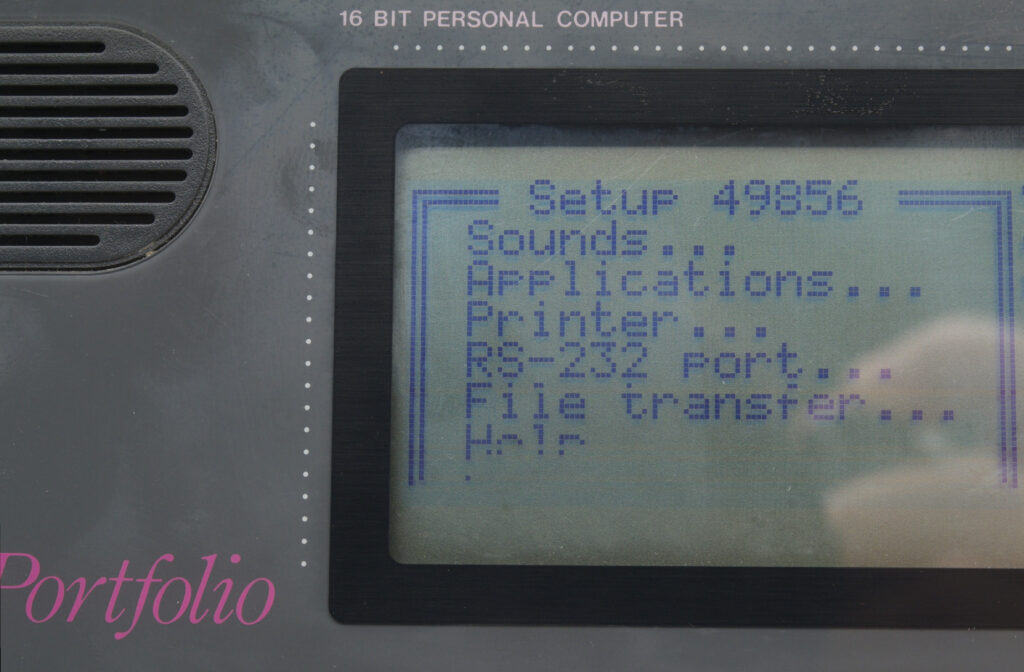
- 240x64 pixels monochrome (8 lines x 40 characters), no backlight
- Operating system:
- DIP DOS 2.11
- Year introduced:
- 1989
- Power source:
- 3 AAA batteries
- Connectivity:
- Parallel and Serial interfaces available as options
- Dimensions (mm):
- 200×105x25
- Weight (g):
- 504
- Built-in apps:
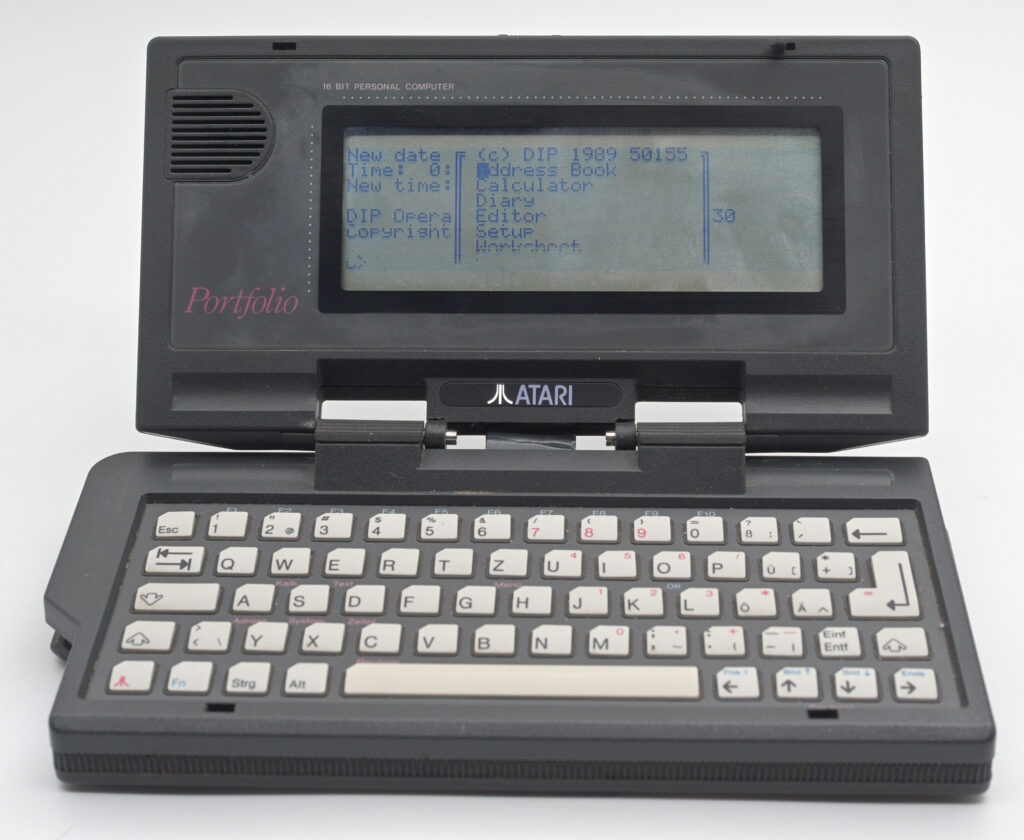
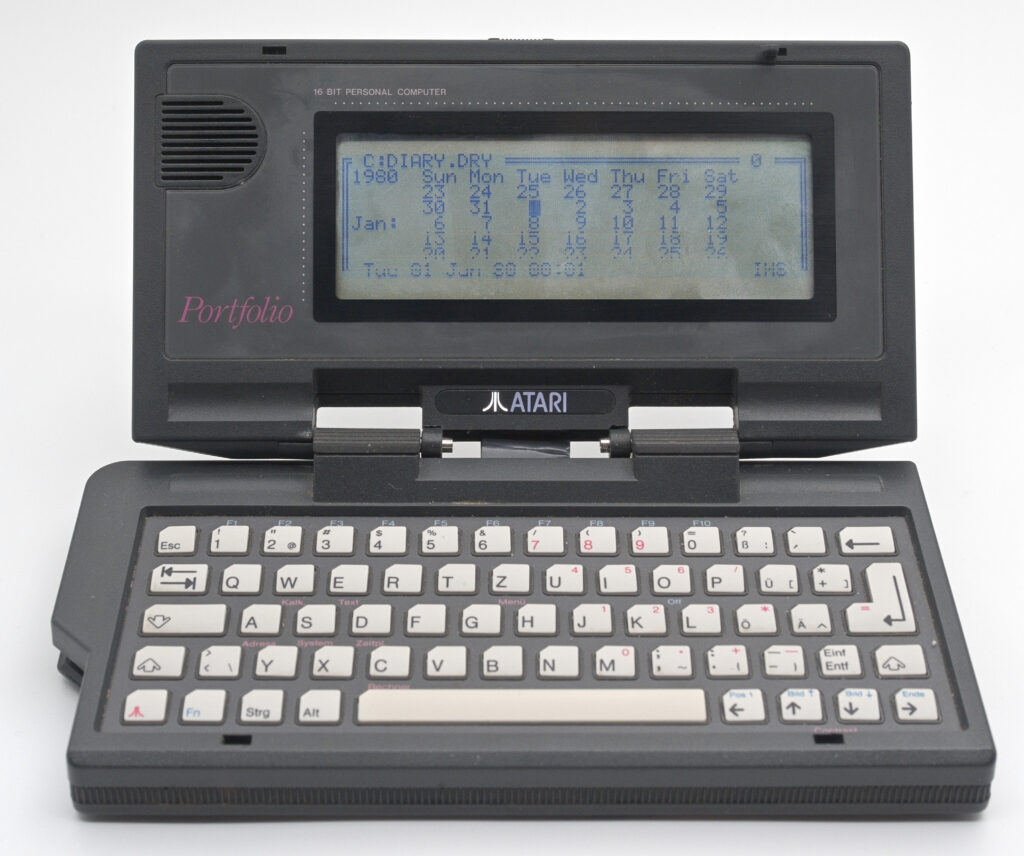
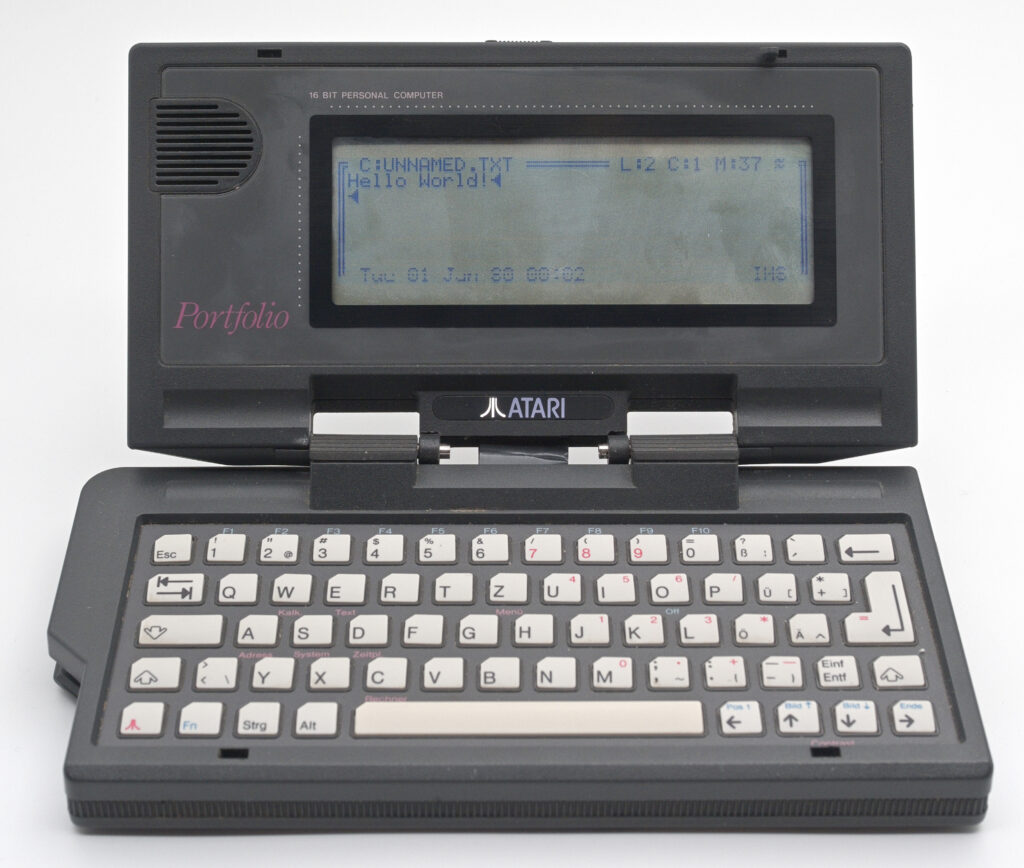
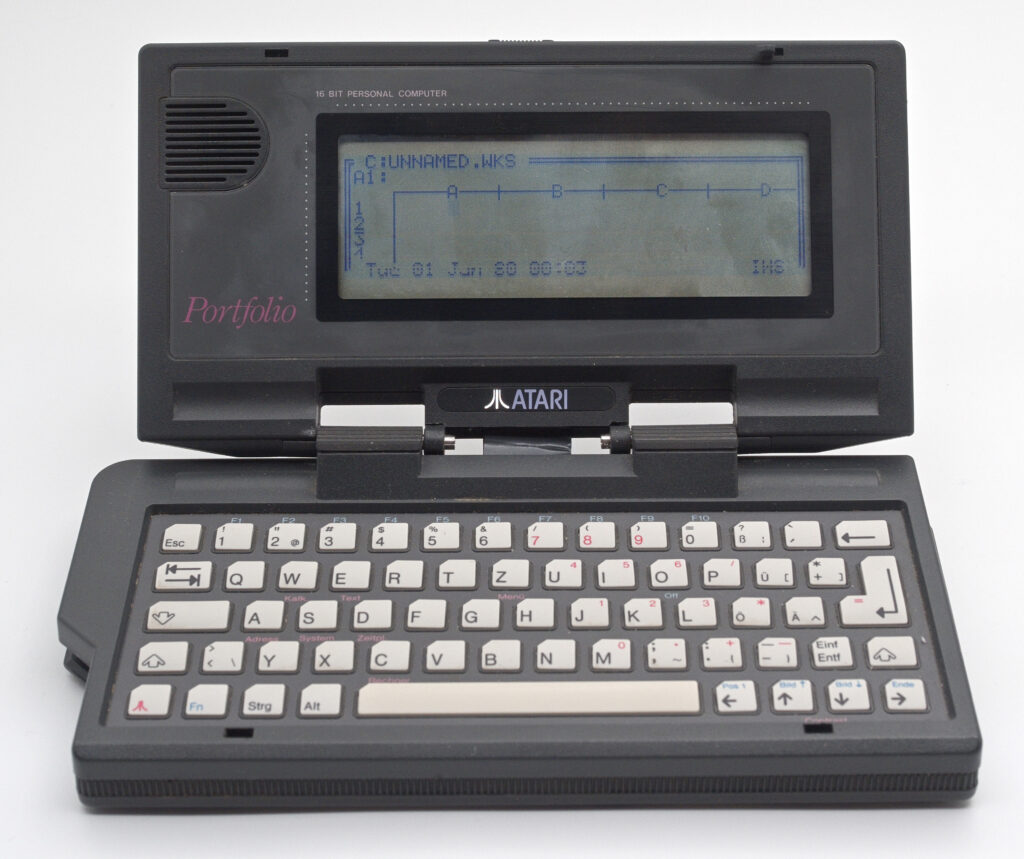
- Address book, Calculator, Diary, Editor, Worksheet
- Input method:
- Keyboard
Background
In the United Kingdom, the computer landscape of the late 1980s differed significantly from that of the United States. While IBM-compatible PCs were beginning to establish themselves, many British users still relied on platforms such as the Amstrad CPC, BBC Micro, and Sinclair Spectrum. At the same time, companies like Acorn were pushing advanced architectures with the Archimedes, and Psion had already found success with its Organiser series, pioneering truly handheld computing.
Against this backdrop, the Portfolio’s origins become particularly interesting. Developed by the UK-based company DIP Ltd, it did not follow the Psion philosophy of building purpose-designed handheld systems. Instead, it represented a different approach: compressing a fully compatible IBM PC into a device small enough to fit in a pocket. This is particularly notable given that several of DIP’s key engineers had previously worked at Psion. Atari licensed the complete design from DIP and simply marketed it under their own name. As DIP failed to attract additional licensees, the design ultimately became known only as the Atari Portfolio.
The Atari Portfolio is widely considered to be the first commercially available palmtop computer.
Hardware
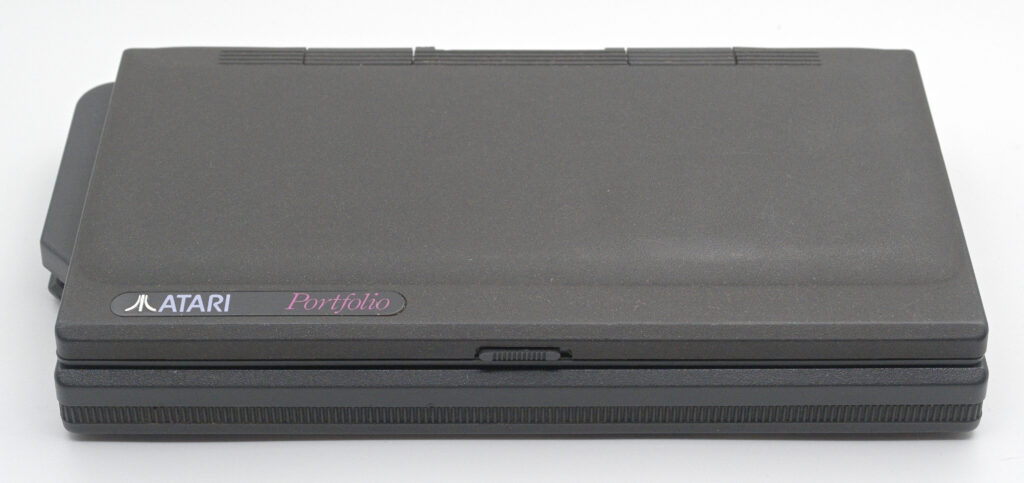
The Portfolio, or the PoFo as it is affectionately known among enthusiasts, is roughly the size of a VHS cassette — for those who remember such things — and weighs around half a kilogram. This makes it significantly smaller than a typical PC it might have complemented, but not quite small enough to fit comfortably in a shirt pocket, something devices like the Sharp IQ-7000, released the same year, could achieve.
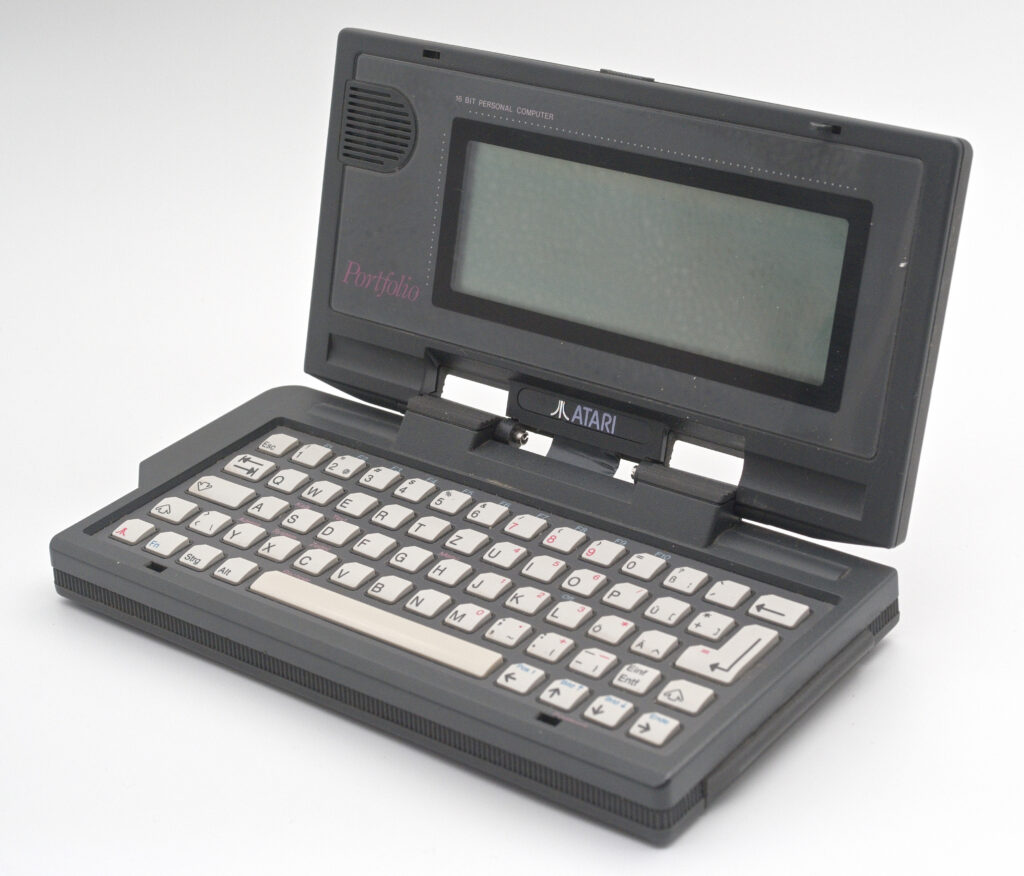
It features a 61-key membrane keyboard, with several keys serving multiple functions.
The display is normally used in text mode, showing 8 lines of 40 characters — roughly one sixth of what a typical PC monitor could display at the time. This significantly limits its usefulness for applications such as word processing and spreadsheets. The display lacks a backlight but can be switched to a graphics mode with a resolution of 240×64 pixels — modest even by late-1980s standards.
At its core is a CMOS version of Intel’s 8088 CPU, running at approximately 4.9 MHz. The system includes 128 KB of RAM and 256 KB of ROM.
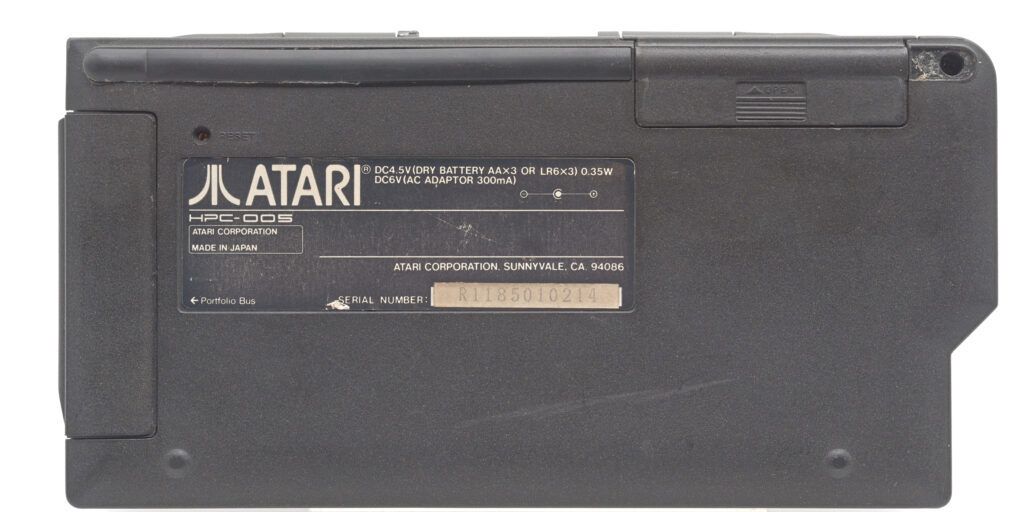
Power is supplied by three AA alkaline batteries, with a claimed battery life of up to six weeks under light use. There is no backup battery for RAM, meaning that data will be lost when the batteries are replaced unless an external 6V power supply is connected during the process.
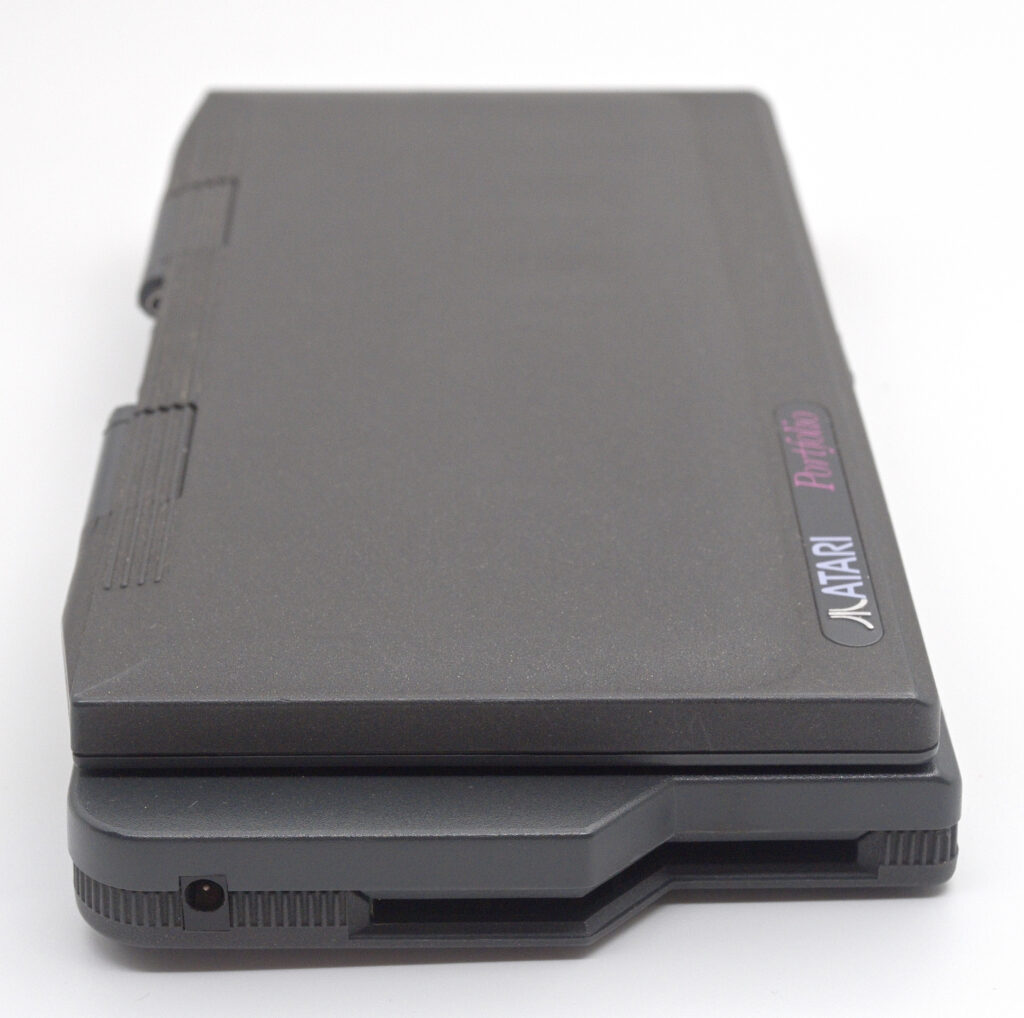
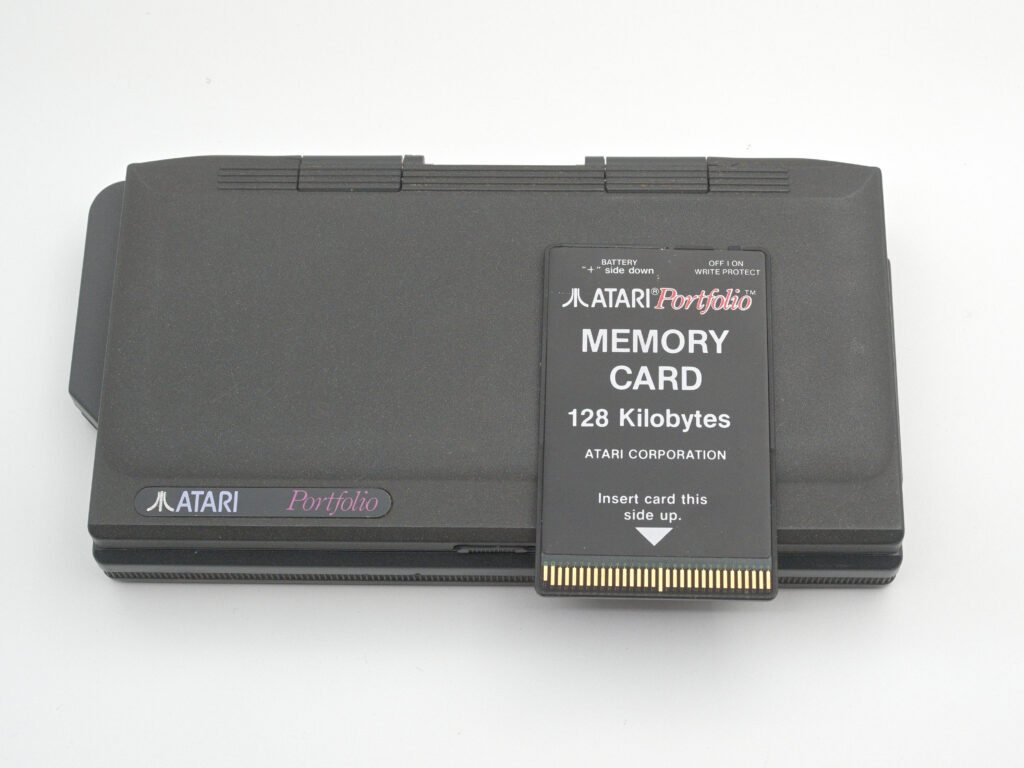
There are two main ways to expand the hardware. On the left side is a slot for memory cards, used primarily for storage. These appear as the A: drive in the system. Cards were available in sizes up to 128 KB (at a considerable cost — around USD 200 at the time). These cards retained their data using a built-in coin cell battery. Although marketed as “PC cards”, they predate and are incompatible with the later PCMCIA standard.
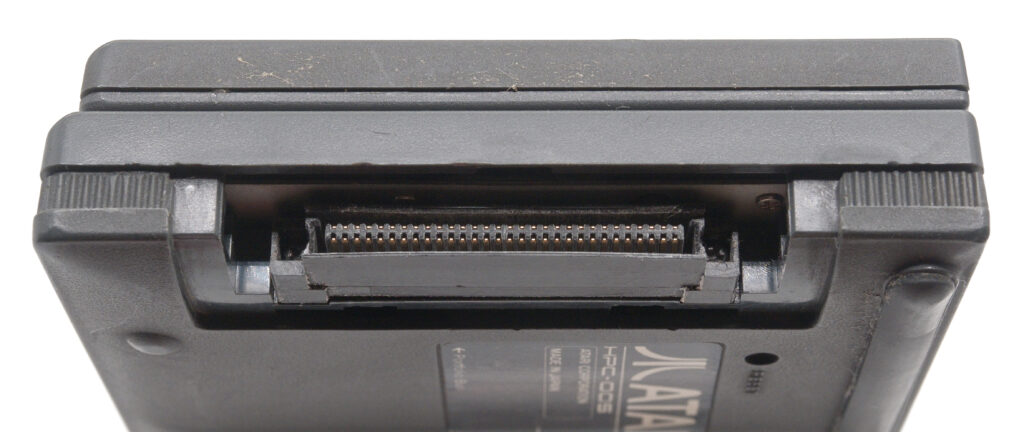
On the right side is a system bus connector. This can be used to attach RAM expansion modules, increasing system memory from 128 KB to 384 KB, or up to the DOS limit of 640 KB by chaining two modules. The same connector also supports various expansion devices, including parallel and serial interfaces, as well as modems.
Software
The Atari Portfolio runs DIP DOS 2.11, an operating system developed by DIP rather than Microsoft. It is partially compatible with MS-DOS 2.11, but the Portfolio’s hardware limitations — particularly its display — mean that many standard DOS applications cannot be used without modification.
The advantage of this near-compatibility is that users familiar with MS-DOS did not need to learn an entirely new system, which was likely one of the Portfolio’s strongest selling points.
A number of applications are built into ROM, including:
- Address Book (capable of dialing phone numbers via the built-in speaker)
- Calculator
- Diary
- Editor
- Worksheet (claimed to be compatible with Lotus 1-2-3)
Because both the operating system and applications reside in ROM, the system starts instantly — a major advantage over many contemporary PCs, especially those relying on floppy disks.
Additional software was available on ROM cards, which, unlike RAM cards, did not require a backup battery.
A small but active enthusiast community also developed software for the Portfolio, including games, many of which are still available today.
Communications
The Portfolio did not include any dedicated synchronization software. In a sense, it did not need to — it was itself a PC. However, transferring files between the Portfolio and a desktop system required additional hardware.
This could be done using either the parallel or serial interface adapters, both of which connected via the system bus. These interfaces supported file transfer to a PC. Another option was a dedicated RAM card reader for desktop systems, allowing files to be read from and written to Portfolio memory cards.
There was no built-in floppy drive, and while some sources claim that an external drive existed, clear evidence of such a product is surprisingly hard to find.
Legacy
As the first commercially available palmtop computer, the Portfolio represents an important milestone. Shrinking a PC to a battery-powered, highly portable form factor had long been a goal, and DIP was the first to achieve it in a commercially viable product.
By using a DOS-like operating system, the Portfolio immediately felt familiar to a large number of users. Its relatively low price — around USD 400 — also contributed to its success.
DIP and Atari were soon followed by other manufacturers producing DOS-based palmtops. Among these, HP would go on to create more refined and practical devices with the 95LX and 200LX, which ran actual MS-DOS.
As the first palmtop computer running a DOS-like system, the Portfolio is an essential piece of computing history. It is particularly interesting to compare it with devices such as the Sharp IQ-7000 from the same year, and the Psion Series 3 released just two years later, illustrating how rapidly the field evolved during this period.
While the Portfolio is not especially practical for everyday use today, it represents a bold and important step in the evolution of portable computing.
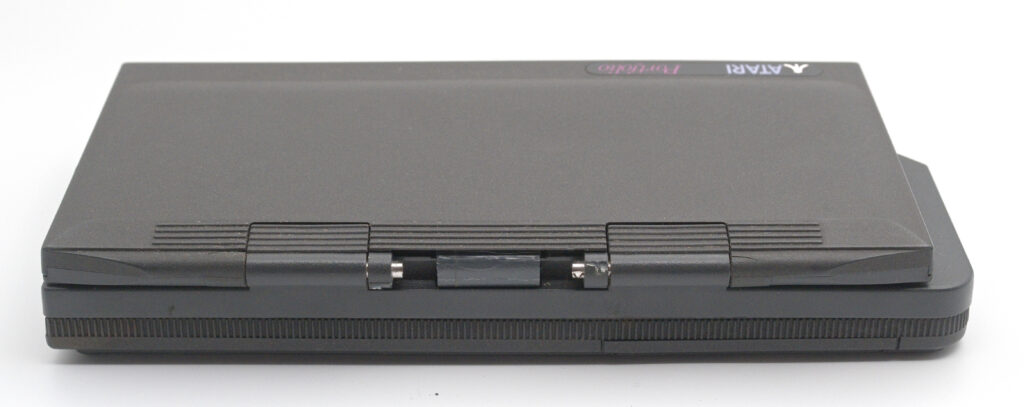
Note. I have two Portfolios, one does not start at all and I suspect problems with electrolytic capacitors. The other, seen in the pictures above, has a german keyboard and has a problem with the lower part of the display.
References
Wikipedia article on Atari Portfolio
Excellent video on the Portfolio from LGR