
The perfect school computer
Quick facts
- CPU:
- ARM 710a @25 MHz
- RAM (KB):
- 1024
- Storage (MB):
- 3072
- Display:
- 480x320 pixels w/ touchscreen and backlight
- Operating system:
- Newton OS 2.1
- Year introduced:
- 1997
- Power source:
- Built-in rechargeable battery
- Connectivity:
- IR, Serianl AppleTalk
- Dimensions (mm):
- 305x114x53
- Weight (g):
- 1800
- Built-in apps:
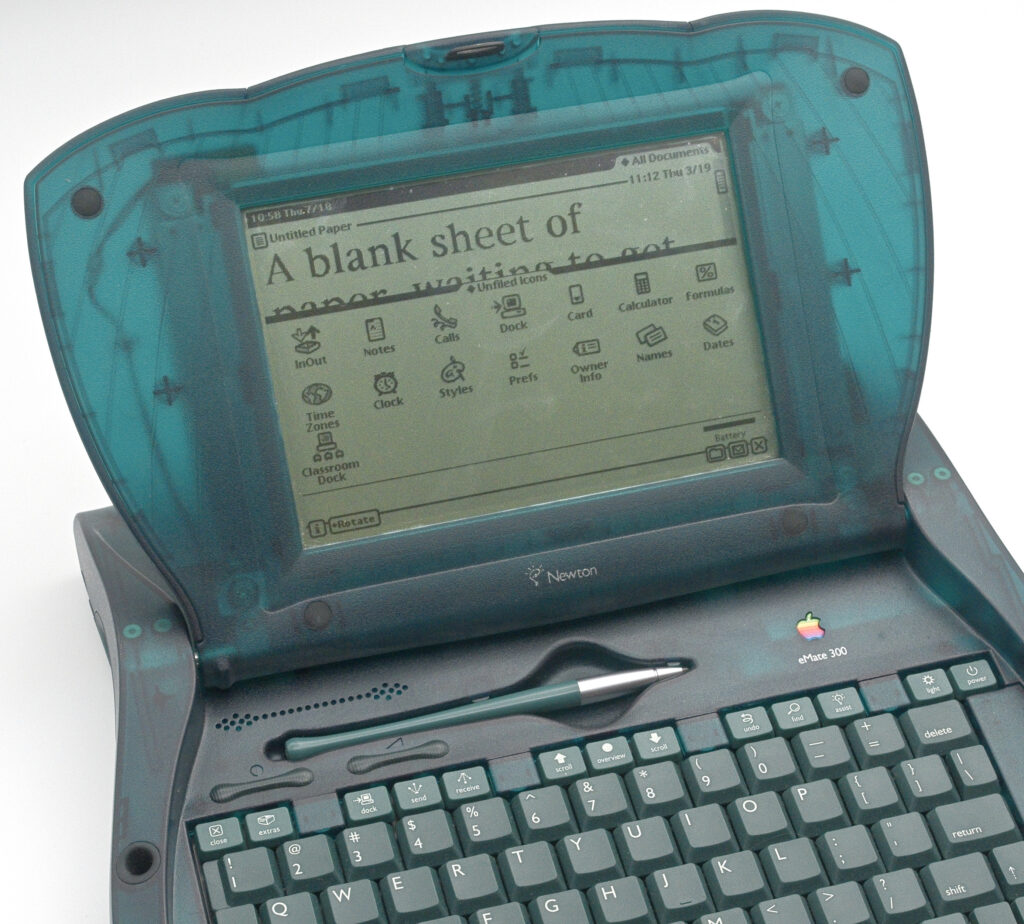
- Notes, InOut, Names, Dates, Calculator, Formulas
- Input method:
- Keyboard and stylus
Introduction
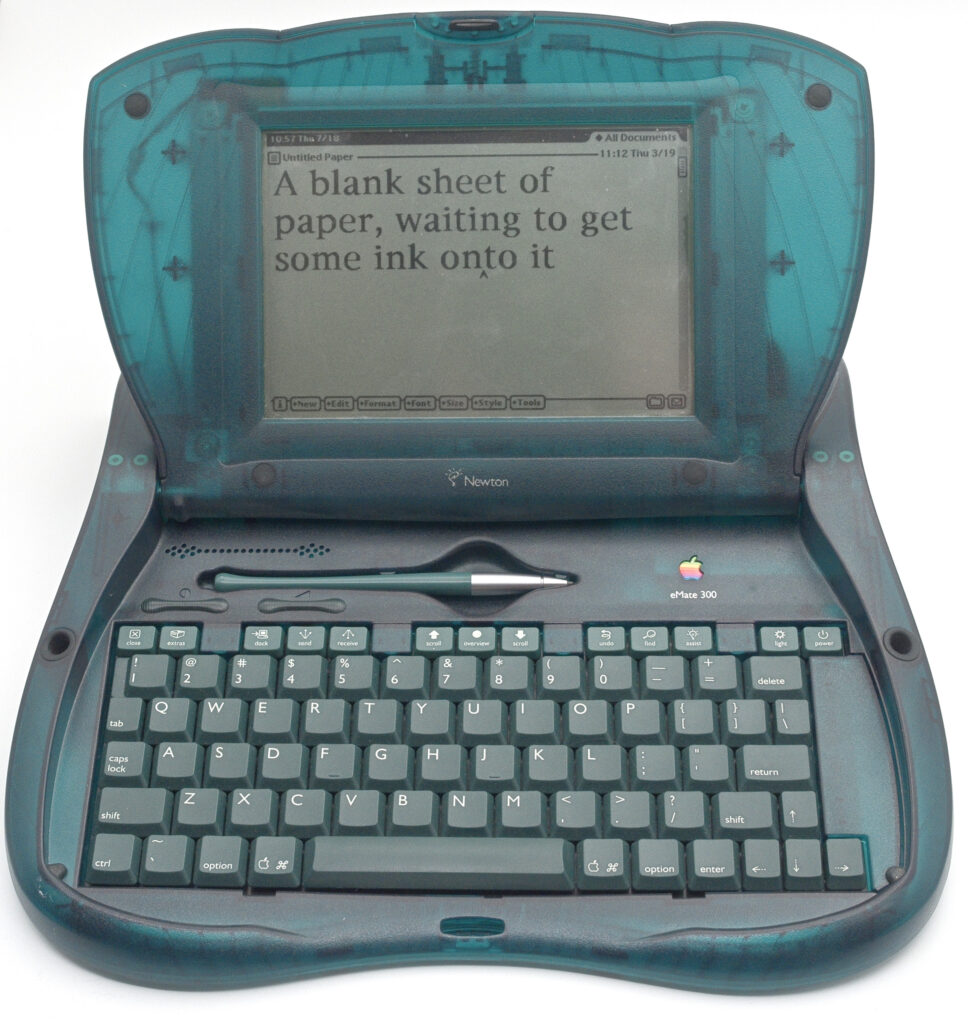
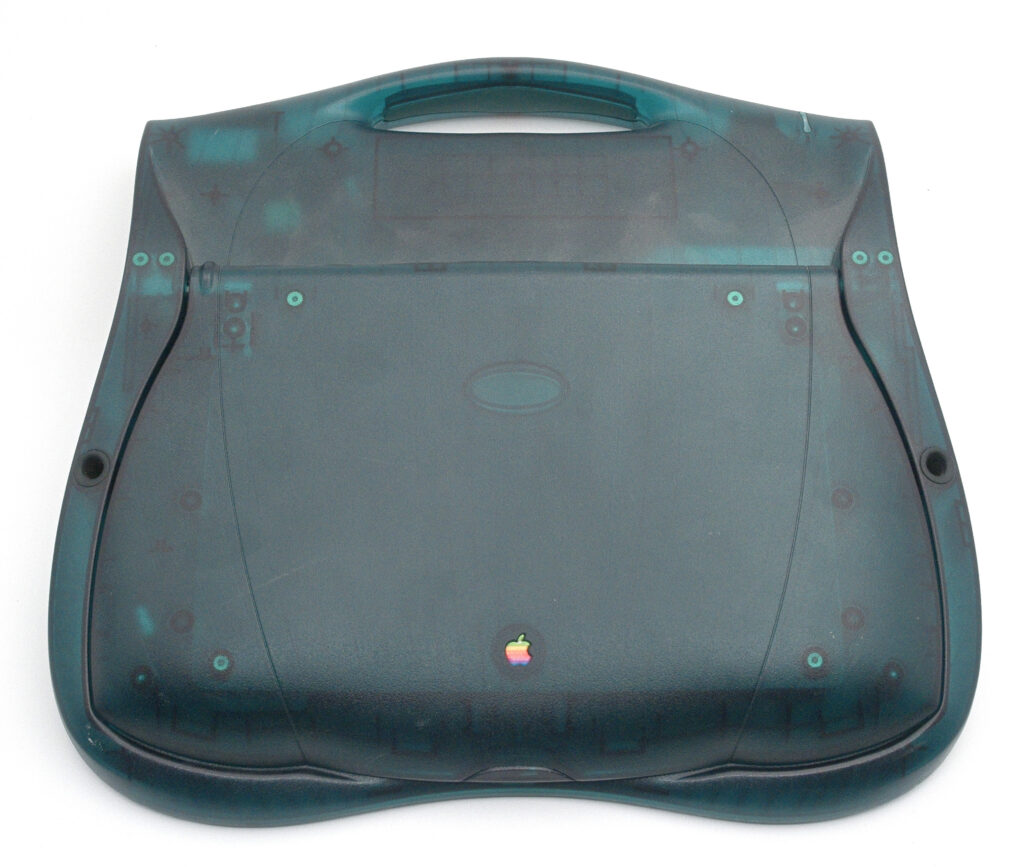
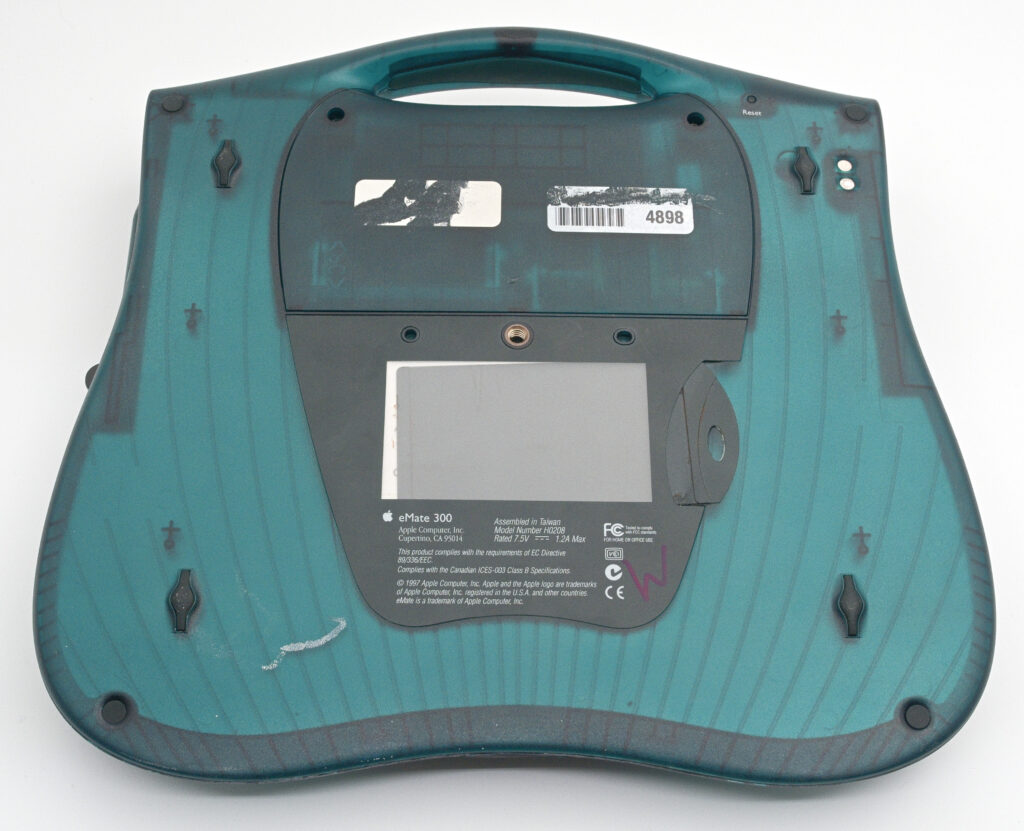
The Apple Newton eMate 300 is unlike any other Newton. It runs the same Newton operating system as the later MessagePads, but its form factor is completely different. Instead of a handheld organizer, the eMate is a rugged, clamshell computer with a built-in keyboard, designed primarily for use in schools. When it was introduced on March 7, 1997, it sold for US$799. That was hardly cheap, but Apple’s other portable computers at the time, such as the PowerBook 2400c and 3400c, were significantly more expensive and far less specialized for classroom use. With its durable design, built-in handle, long battery life, instant-on behavior, and classroom-oriented software, the eMate was a remarkably well thought-out computer for education.
Hardware and communications
The eMate is powered by a 25 MHz ARM 710a processor. Compared with the contemporary MessagePad 2000, which used a much faster StrongARM processor, the eMate was clearly the less powerful machine. It came with 1 MB of DRAM and 2 MB of flash storage, and it ran Newton OS 2.1. Even so, raw performance was not really the point. The eMate was built to be practical, dependable, and easy to use in a school setting rather than to compete as the most advanced Newton.
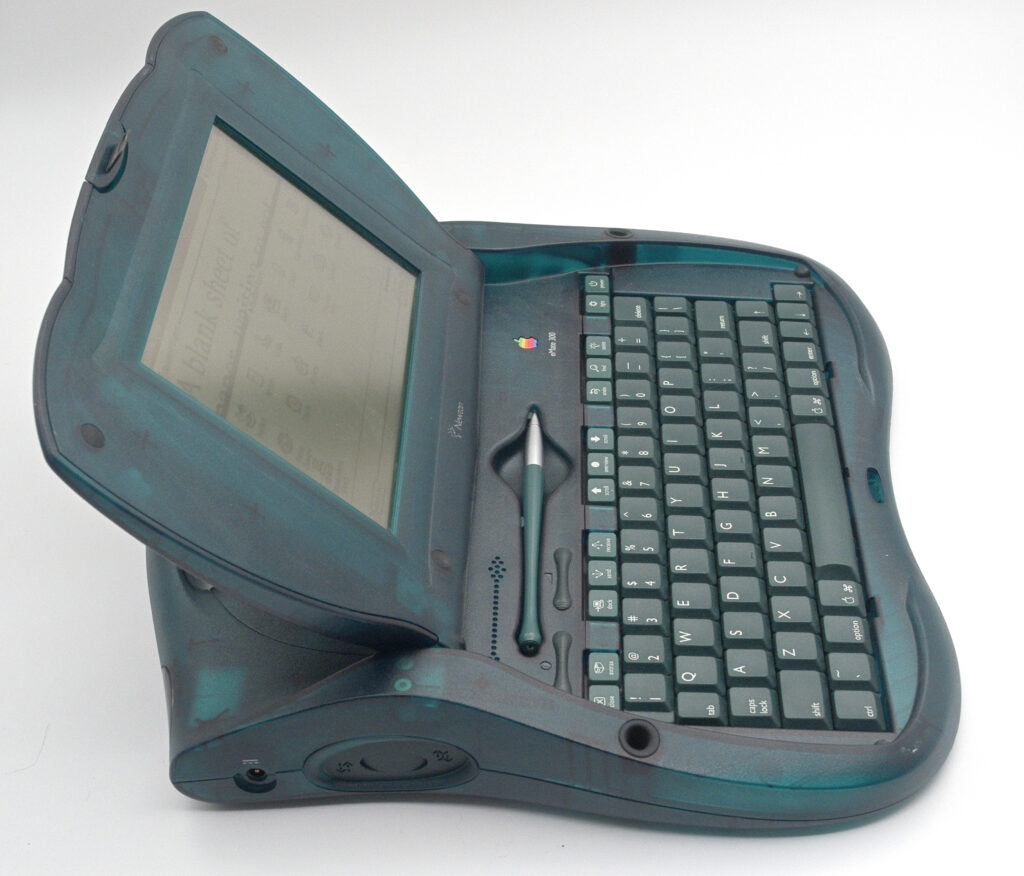
The keyboard is about 85 percent of full size, yet it is surprisingly comfortable to type on. For many users, it is perfectly usable for touch-typing. At the same time, the eMate is not fully operable from the keyboard alone, since Newton OS still depends heavily on pen input. A stylus is therefore included and stored above the keyboard. In a nice touch clearly aimed at practical everyday use, there are parking places for the stylus on both sides of the keyboard, making it equally convenient for right-handed and left-handed users.
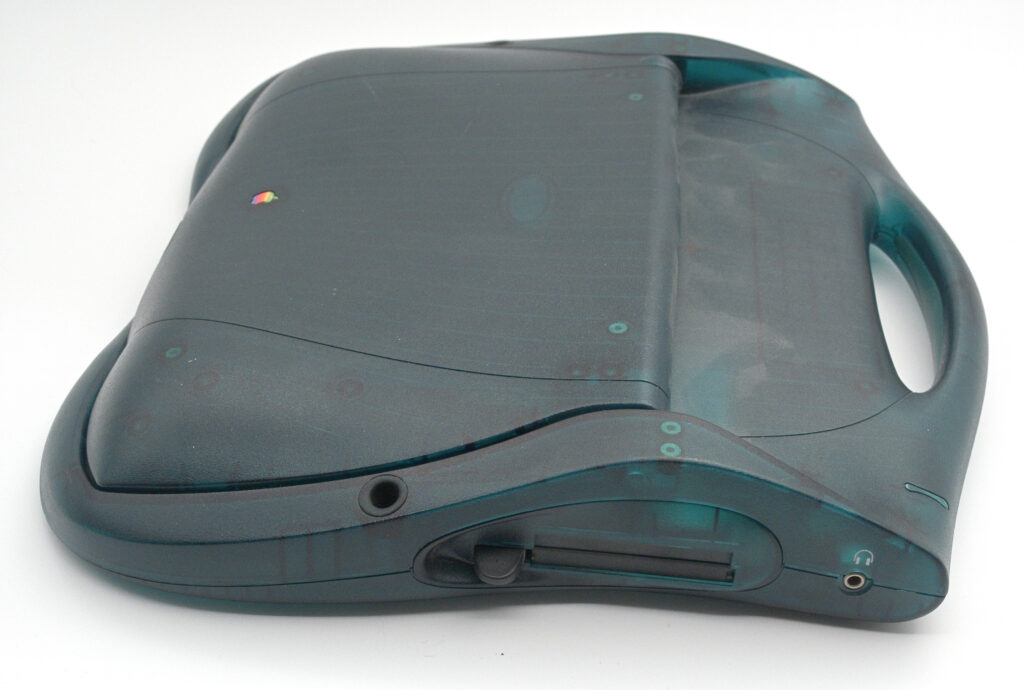
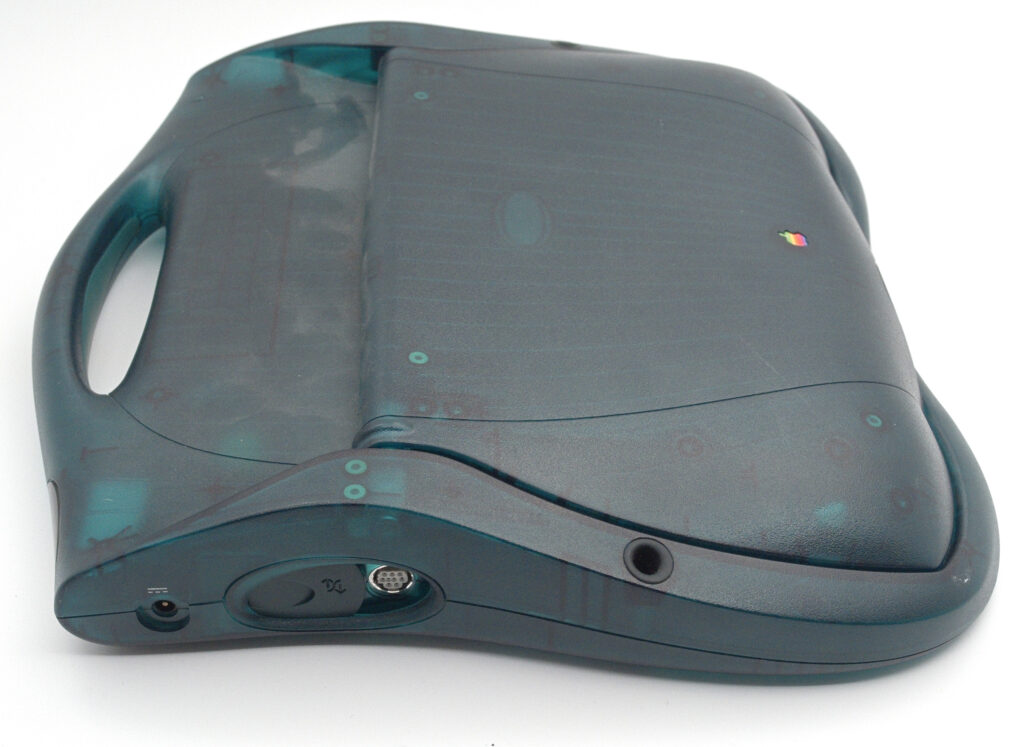
Like other later Newton devices, the eMate includes an infrared port, which can be used to beam information to another Newton. It also supports connections to desktop computers via serial or AppleTalk, depending on the software and setup being used. For school environments, Apple placed particular emphasis on easy communication with classroom systems and desktop machines.
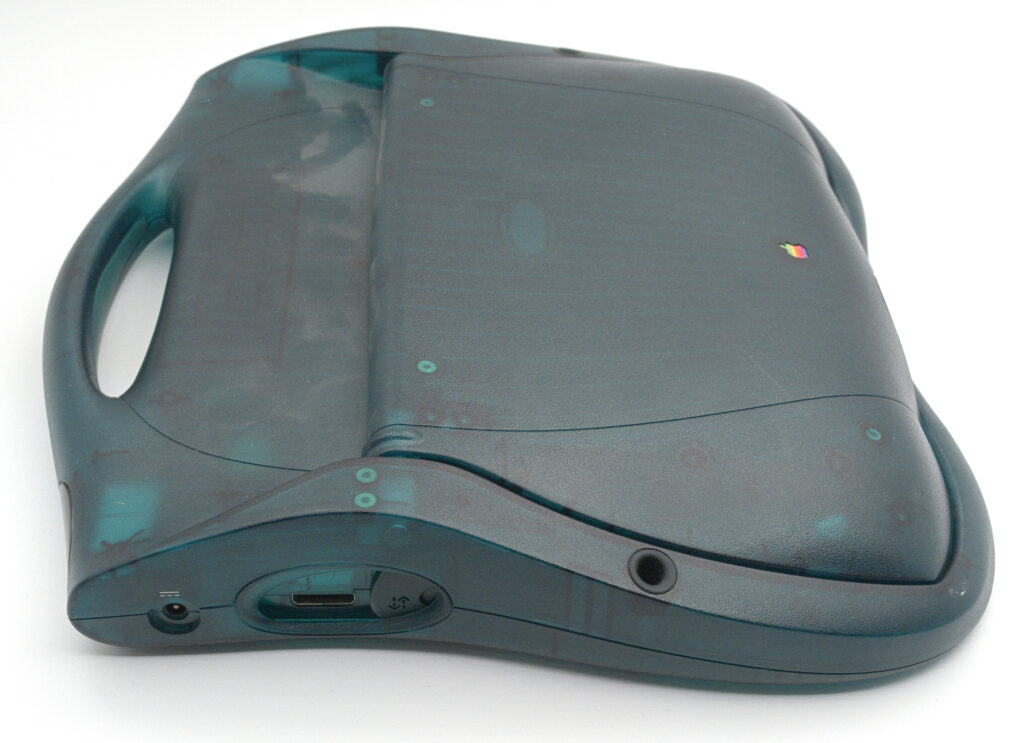
Power comes from a built-in rechargeable battery pack that Apple rated at up to 28 hours of use, an impressive figure for the time. The eMate also had an internal expansion slot for memory upgrades, something the MessagePad line did not offer in the same way. The eMate includes a single PCMCIA slot, but unlike many devices of the time, it supports the full Type III form factor. This allows the use of thicker cards such as hard drives, or two Type II cards via an adapter, giving the machine surprising flexibility. PCMCIA cards for storage, modems, Ethernet cards, and other communications hardware were available.
Visually, the most striking thing about the eMate is its translucent green shell. At the time, this looked radically modern and unlike almost anything else on the market. In retrospect, it is hard not to see it as a design forerunner to the translucent plastics Apple later made famous with the iMac.
Software
The software experience is centered around writing and schoolwork. Newton Works is especially important here, and on a factory-default eMate it is set as the backdrop application, meaning that it is effectively what greets the user first. This makes perfect sense, since the eMate was designed less as a general-purpose PDA and more as a machine for taking notes, writing assignments, drawing, and doing schoolwork. The standard Newton personal information tools are also present, including calendar, names, notes, and communication features. Messaging tasks such as e-mail and fax, when the necessary hardware and services were available, were handled through the InOut Box.
One of the most interesting features of the eMate is its classroom-oriented software. Apple provided a special Classroom Mode as well as eMate Classroom Exchange, which allowed several eMates to connect to a single desktop computer using serial or AppleTalk connections. In Teacher Setup, an administrator could decide whether the machine should run in full Newton mode or in a more restricted classroom configuration. It was also possible to control which applications were available to students, manage multiple users, require passwords, and limit logins to approved users only. This gave teachers a level of control that was highly unusual for portable computers of the time.
For a school environment, Newton Works was particularly valuable because it bundled word processing, spreadsheet, and drawing tools into a single integrated package. Combined with the eMate’s excellent battery life and instant-on convenience, it made the machine genuinely useful in day-to-day classroom work rather than just interesting in theory. Third-party software was also available, further extending the system beyond its built-in capabilities.
Was it successful?
The eMate was never around long enough to become a long-term success. When Steve Jobs returned to Apple, the Newton line was discontinued, and with it the eMate. Officially, the eMate 300 was discontinued in early 1998, less than a year after its introduction. That makes it easy to view it as a commercial dead end.
And yet, the eMate was important. Apple had clearly identified a real need: a portable computer for schools that was durable, simple to manage, had long battery life, and could be restricted to approved uses in the classroom. In that sense, the eMate anticipated a concept that would become much more successful many years later with devices such as Chromebooks. The eMate did not create that market on its own, but it showed that Apple had understood the idea surprisingly early.
The eMate is the odd one out in the Newton family. If it had run almost any other operating system, it would probably have been remembered simply as a small educational laptop. But because it runs Newton OS, it belongs naturally alongside the MessagePads and other Newton devices, even though it looks and behaves very differently from them. That alone makes it interesting.
It is also fascinating as an early attempt at the dedicated school computer: rugged, portable, battery-efficient, and designed to operate within limits set by the teacher or administrator. Many companies explored similar ideas in the 1990s, but the concept would not fully take off until much later. The eMate therefore stands not only as a strange and appealing Newton, but also as a remarkably early vision of the modern classroom computer.
References
Wikipedia page on eMate 300