
The Organizer That Wanted to Grow Up and Become a PDA
Quick facts
- CPU:
- Proprietary
- RAM (KB):
- 32
- Storage (MB):
- -
- Display:
- 96x64 pixels and 8x16 characters monochrome LCD without backlight
- Operating system:
- Proprietary
- Year introduced:
- 1989
- Power source:
- 2xCR2032 + 1xCR2016 for backup
- Connectivity:
- Serial
- Dimensions (mm):
- 163x94x22
- Weight (g):
- 253
- Built-in apps:
- Calendar, Phone- and address-book, Home- and world times, Memos, Calculator
- Input method:
- Keyboard
Overview
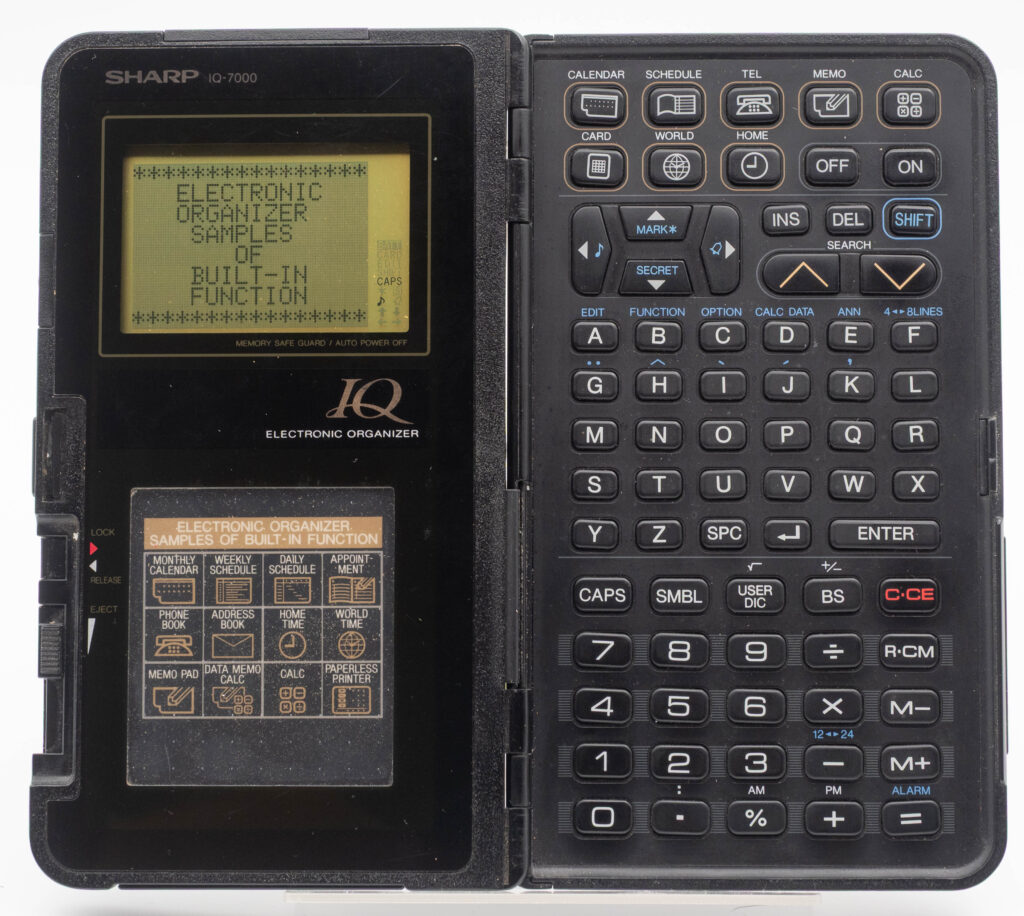
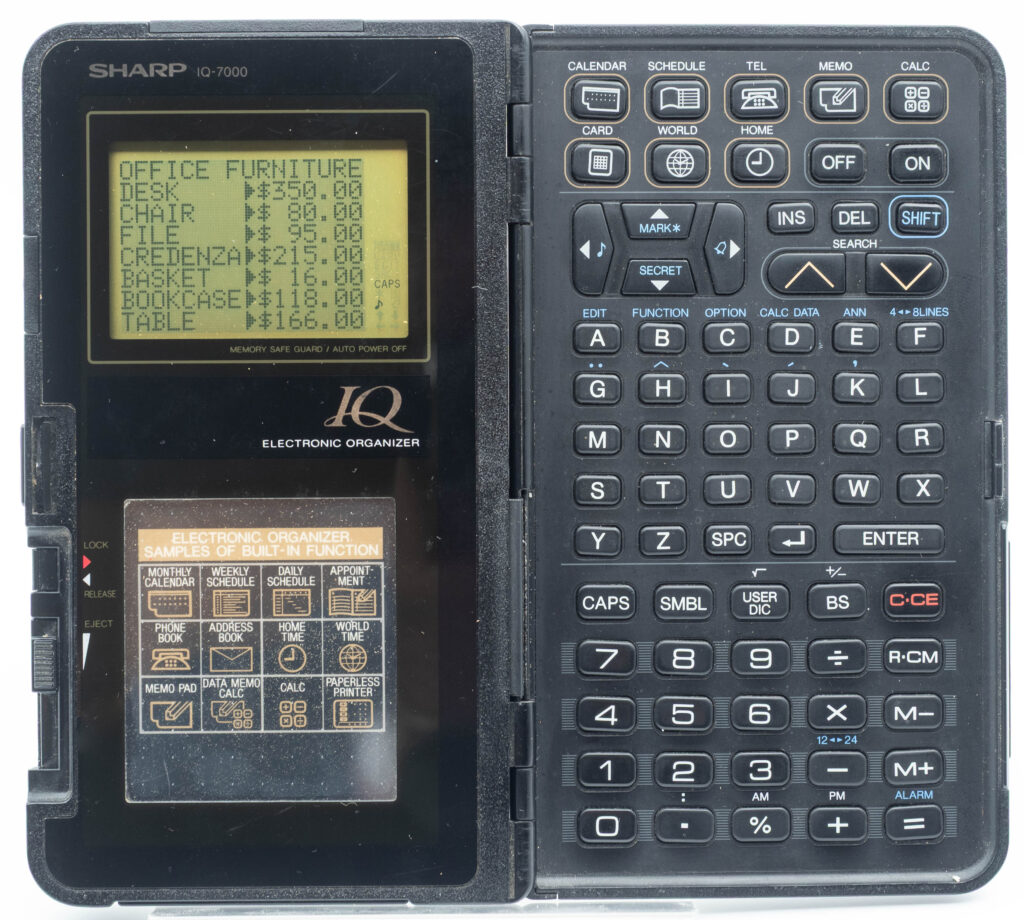
Sharp, long recognized for its expertise in low-power electronics and LCD displays, was one of the world’s major manufacturers of calculators and so-called “data banks” or organizers throughout the 1970s and 1980s. As such, the company already possessed most of the technological building blocks needed to push the organizer concept one step further. The IQ-7000 represents Sharp’s first serious attempt to do exactly that. At an introductory price of USD 299, it was inexpensive enough to become a commercial success and spur Sharp to develop follow-ups.
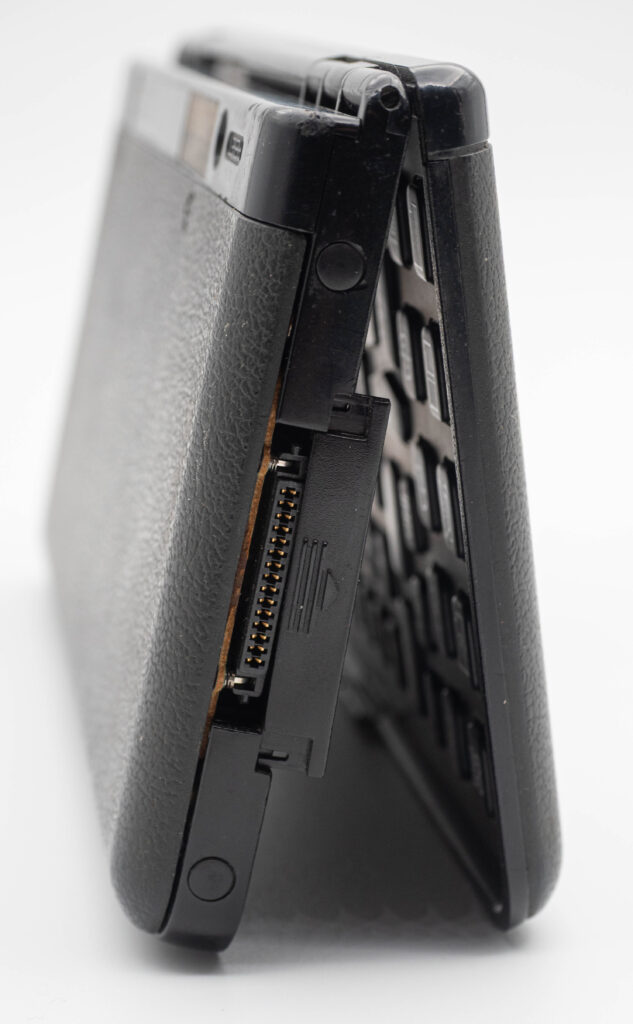
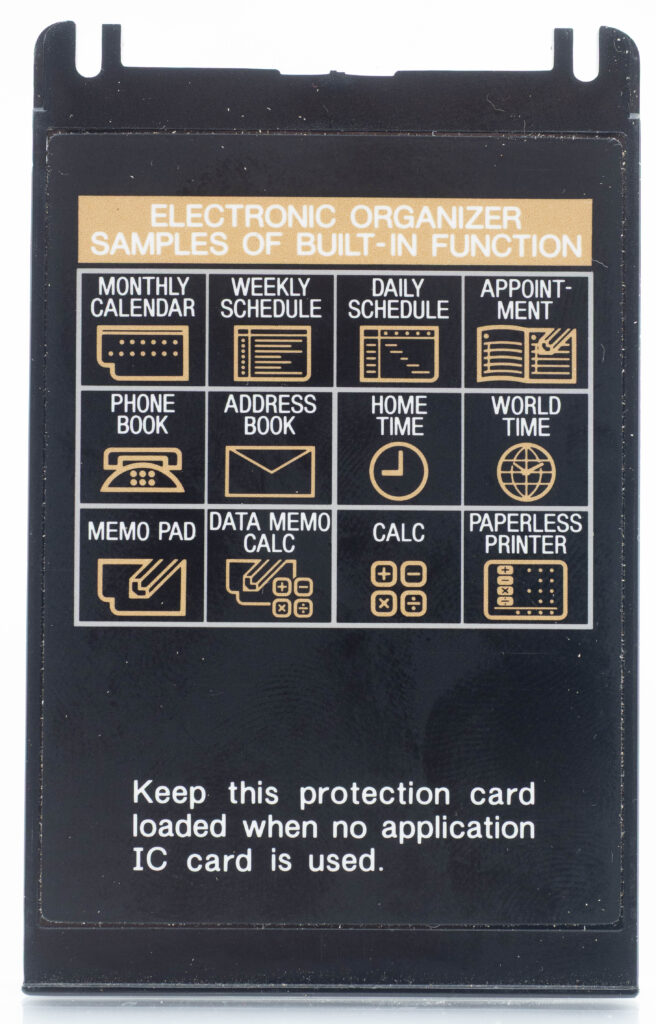
Introduced as the first model in what would become the Wizard series, the IQ-7000 added two features that clearly distinguished it from earlier electronic diaries: expandability and PC connectivity. Expansion was provided through so-called IC cards, which were essentially ROM cards containing additional software. RAM cards were also available, allowing users to increase the device’s data storage. Physically, these cards were similar in size to the later PCMCIA format, but they were not electrically or logically compatible.
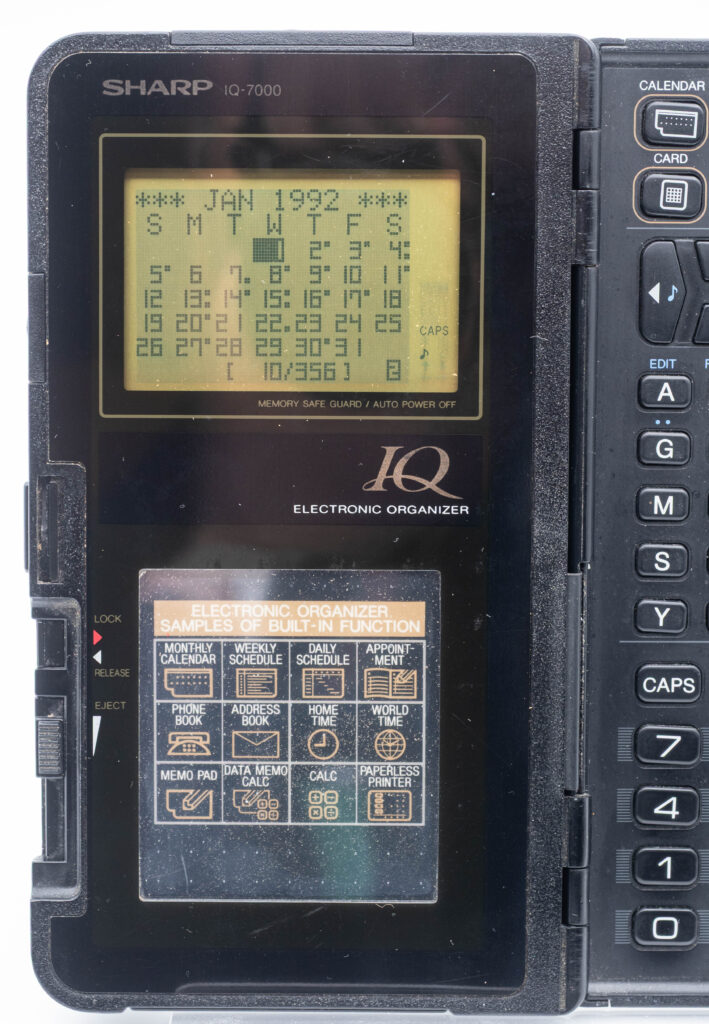
One of the IQ-7000’s most distinctive design features was the way these IC cards were used. They were inserted behind a transparent window that also functioned as a touch-sensitive digitizer. A typical mathematics card, for example, would print trigonometric functions directly on the top of the card, aligned with touch-sensitive zones in the transparent window. By pressing on the corresponding area of the window, the user could invoke that specific function. This clever combination of physical labeling and electronic input created a hybrid interface that was both intuitive and visually expressive.
The IQ-7000 featured a serial port with a proprietary connector, which allowed it to connect to a personal computer or to another Sharp organizer for data exchange. It could also be used with a thermal printer and even a cassette recorder, reflecting an era in which digital storage and transfer were still closely tied to analog media.
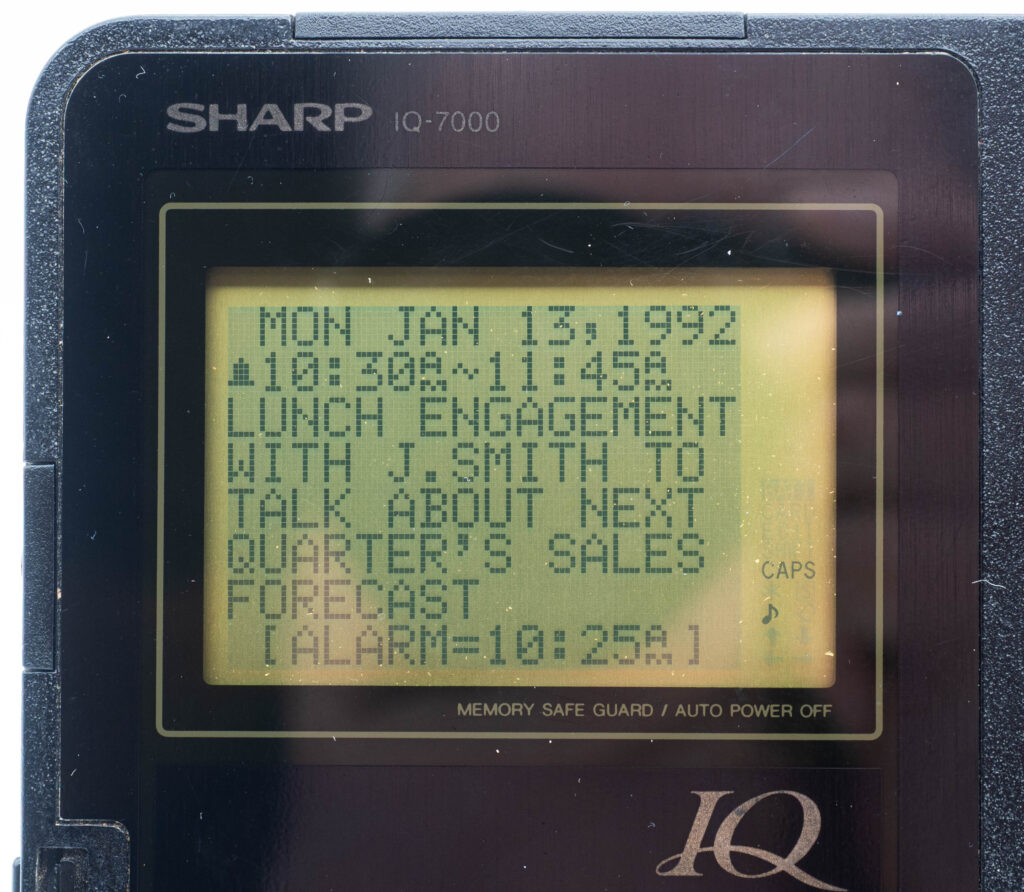
The display was a monochrome LCD capable of operating in several modes. It could show:
- 8 lines of 16 characters,
- 4 lines of 12 characters, or
- a graphical mode at 96 × 64 pixels.
The keyboard was arranged in alphabetical order, with separate sections for numerals and function keys. Unlike many later clamshell-style PDAs, the IQ-7000 was designed to be held and operated in portrait orientation.
The built-in software reflected the classic organizer role of the device. It included applications such as Calendar, Schedule, Appointments, Phone Numbers, Address Book, Home and World Time, Memos, and Calculator. Optional IC cards greatly expanded this functionality, adding tools such as a thesaurus, scientific calculator, translators, various encyclopedic reference modules and even some games.
What Came After the IQ-7000?
Several enhanced models followed within the IQ-7000 and broader Wizard series during the early 1990s. In 1993, Sharp introduced the Zaurus, a device that more closely resembled contemporary PDAs from manufacturers such as HP and Psion. These newer designs combined a keyboard with pen-based input and embraced a more general-purpose computing model. Unlike its competitors, however, the Zaurus line was built around a Sharp-specific operating system, marking a distinct technological path.
The Sharp IQ-7000 represents a stepping stone between a popular category of devices once known as “data banks” or “organizers” and what would later be called the PDA. From a technological perspective, it raises fascinating questions: What was possible in a device powered only by two coin cells? How could expansion and software ecosystems be designed in a world before flash memory and app stores? In this sense, the IQ-7000 stands not just as a product, but as an experiment in how far the organizer concept could be pushed toward becoming a true handheld computer.
References
The Wikipedia-page on the Sharp Wizard series
Sharp IQ-7000 in the Virtual Museum of Calculators