
How a wooden block, a new alphabet, and a clear vision reshaped handheld computing
Introduction
In 1996, Palm, Inc. of Sunnyvale, California released the Palm Pilot. It became an immediate commercial success, and together with its successors, Palm devices went on to dominate the PDA market for several years. This naturally raises the question: what was it about the Palm Pilot that allowed it to so quickly outcompete its rivals?
To answer that, we need to examine both the state of handheld computing at the time and the background of Palm’s founder, Jeff Hawkins, before the Palm Pilot came into being.

Handheld computing before the Palm Pilot
During the second half of the 1980s and the first half of the 1990s, many companies experimented with handheld computers. Different form factors, input methods, and software concepts were explored, but there was no clear winner. Most products were either technically impressive but impractical, or innovative yet commercially unsuccessful.
Examples from this period include the Amstrad PenPad PDA600, an early attempt at handwriting recognition that largely failed to deliver usable results. The Psion range of handheld computers was more successful and technically refined, but remained largely confined to its home market in the UK.
Jeff Hawkins was already active in this space. Before founding Palm, Inc., he worked at GRiD Systems, where he helped develop the GRiDPad in 1989—an early tablet computer used by organisations such as police departments and inventory managers. Although the GRiDPad sold reasonably well, Hawkins later described it as a failure: it was too large, too slow, and too cumbersome for everyday use.
Palm, Inc., founded in 1992, initially focused on software rather than hardware. One of its early projects was software for the Tandy Zoomer, a device manufactured by Casio for Tandy. In concept, the Zoomer was closer to the later Apple Newton than to what would eventually become the Palm Pilot. Working on the Zoomer taught Hawkins a crucial lesson: it was easier to teach humans to adapt their writing slightly than to teach computers to understand unrestricted handwriting.
Graffiti
The result of this insight was Graffiti, a simplified, stylus-based input system designed to be both fast and reliable. Each character was written using a single, well-defined stroke. While the idea had some conceptual similarities to the Unistroke alphabet developed at Xerox PARC in 1993, Graffiti was a distinct implementation.
Despite the differences, Xerox sued Palm for patent infringement, resulting in a legal battle that lasted nearly nine years before being settled out of court. Graffiti itself was invented by Jeff Hawkins, but engineers such as Joe Sipher and Ron Marianetti played a key role in refining it into a robust and learnable input system.
The wooden block — or the “pretotype”
Determined not to repeat what he considered earlier mistakes, Hawkins took an unconventional approach to designing a new PDA. Instead of starting with specifications or committees, he began with a physical experiment.
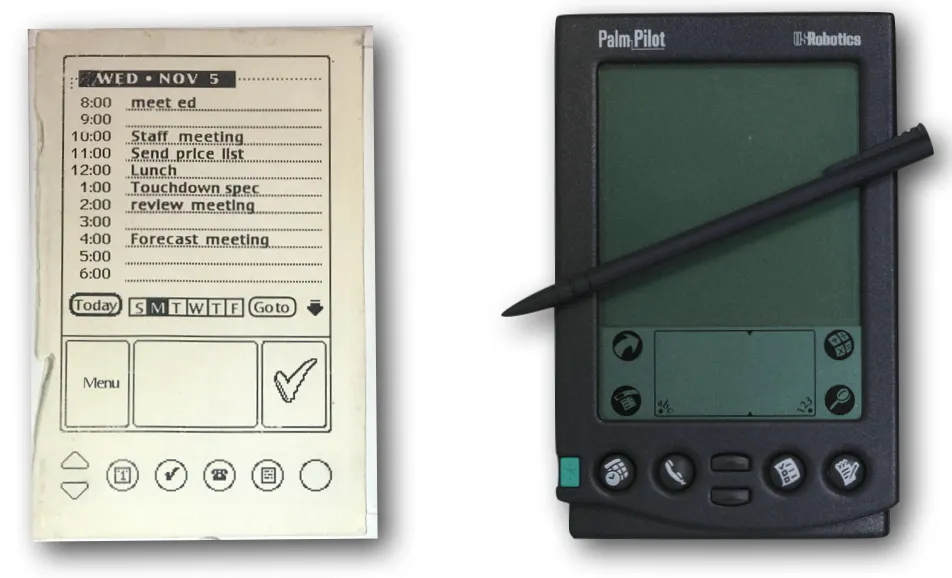
He created a wooden block with the dimensions he envisioned for the final device. On paper, he sketched mock-ups of applications he believed would be useful—calendar, contacts, notes—and placed these sheets on the block. He then carried this “pretotype” in his shirt pocket for over a month. When asked about meetings, lunches, or phone numbers, he would pull out the block, flip through the paper screens, and simulate using the device.
Only after confirming that the form factor and application set were genuinely useful in daily life did Hawkins proceed to build a real electronic prototype.
Why this approach worked
This method was highly unusual. Most products are defined by requirements documents and committees long before real-world usability is tested. Hawkins’ approach reversed this process—and it proved remarkably successful.
Several key principles emerged:
- Size: If a device does not fit comfortably in a pocket, it will not be carried regularly.
- Immediacy: Accessing information must be faster than using pen and paper.
- Right built-in applications: Address book, calendar, and memos should be present from day one.
- Useful battery life: Weeks of use on ordinary batteries, not hours or days.
- A companion to the PC: The PDA should complement, not replace, the desktop computer, with effortless synchronisation.
These principles defined the Palm Pilot—and set it apart from its competitors.
Market dominance and evolution
When Palm introduced the Pilot 1000 and 5000, followed by the PalmPilot Personal and Professional, the devices were instant successes. Between 1996 and roughly 2002, Palm dominated the PDA market. At its peak around 1999–2000, Palm reportedly held approximately 85% market share.
Palm also licensed Palm OS to other manufacturers, most notably Sony, whose Clié series explored more advanced hardware while retaining the Palm software ecosystem.
Between 1996 and 2007—a period of just eleven years—Palm released 24 different PDA models. Many were incremental updates, differing mainly in RAM size or CPU speed, but significant architectural changes also occurred. These included higher-resolution displays and a transition from Motorola’s DragonBall processors (closely related to the 68000 family used in early Macintosh and Amiga systems) to ARM-based CPUs in the Tungsten series.
Corporate changes and shifting vision
Palm’s corporate history was as eventful as its product evolution. The company was acquired by U.S. Robotics in 1995, which in turn was acquired by 3Com in 1997. Palm became an independent subsidiary, but disagreements soon emerged between 3Com’s management and Palm’s original founders regarding the company’s future direction.
In 1999, Hawkins and the other founders left Palm to form Handspring, which pursued a more consumer-oriented vision while continuing to license Palm OS. Palm itself increasingly focused on professional and enterprise markets.
Over time, the branding also changed repeatedly: Pilot, PalmPilot, U.S. Robotics Palm, 3Com Palm, and eventually palmOne. Early name changes were driven by trademark disputes with the Japanese pen manufacturer Pilot, while later changes reflected shifts in ownership and corporate structure.
Using Palm devices in 2026
Although smartphones have long since replaced PDAs as mainstream personal computing devices, Palm OS systems remain actively used and explored by enthusiasts. New software, documentation, and tools continue to appear.
One of the best starting points today is palmdb.net, an active community archive offering freely downloadable software, documentation, and discussion. Another lively hub is the Palm subreddit at
https://www.reddit.com/r/Palm/
For those without physical hardware, the CloudPilot project on GitHub provides an online Palm OS emulator capable of running multiple OS versions. ROM images are required, and these can typically be found via the Internet Archive.