
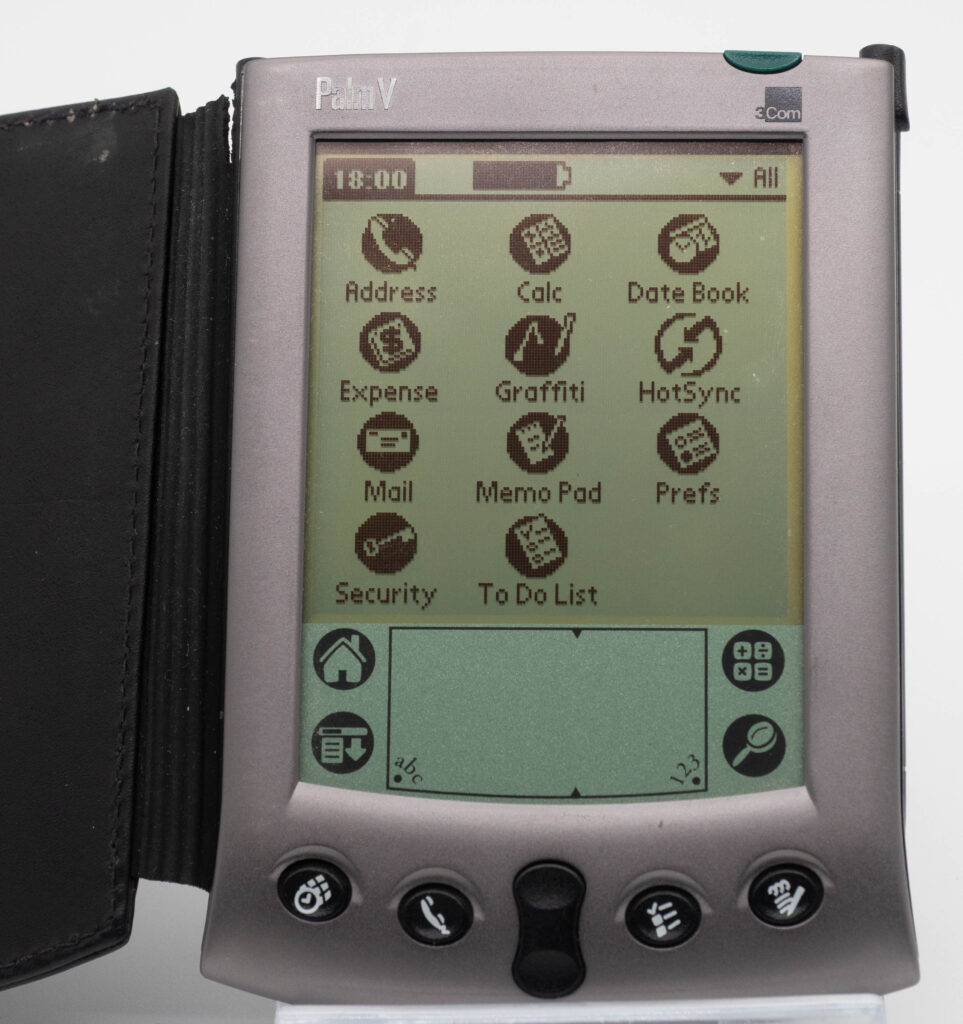
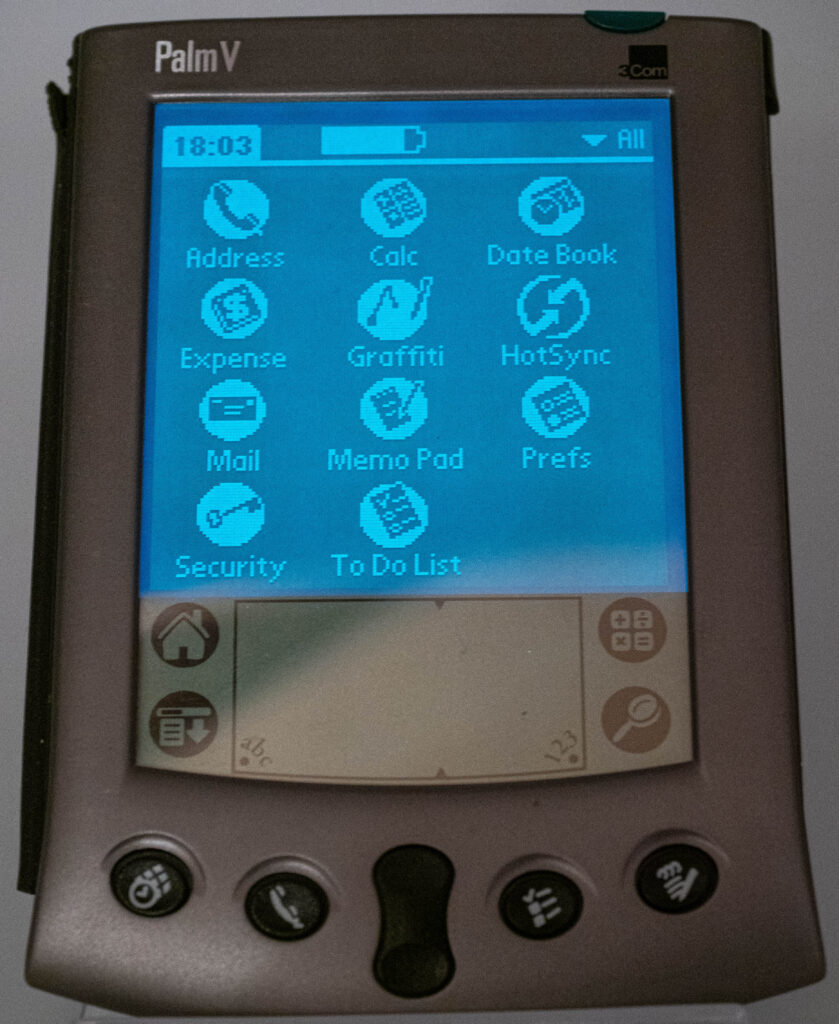
Thinner, smaller and more stylish than the Palm III — and including a built-in Li-ion battery.
Quick facts
- CPU:
- Motorola Dragonball EZ, 68EZ328 @ 16 MHz
- RAM (KB):
- 2048
- Storage (MB):
- 2
- Display:
- 160x160 pixels with 16 levels of grey
- Operating system:
- Palm OS 3.1 (upgradeable)
- Year introduced:
- 1999
- Power source:
- Built-in Li-ion battery
- Connectivity:
- Serial (proprietary connector)
- Dimensions (mm):
- 80x115x10
- Weight (g):
- 115
- Built-in apps:
- Address, Calc, Date Book, Expense, Mail, Memo Pad, To Do list
- Input method:
- Pen
Overview
Introduced in 1999 at a launch price of USD 500, the Palm V was the first in a new line of Palm PDAs to feature a sleek aluminium case. Compared to the plastic-bodied Palm III, it was thinner, smaller, and lighter, marking a clear shift toward a more premium and design-focused product. One of its most significant innovations was the built-in rechargeable lithium-ion battery, which according to contemporary sources provided between one and two weeks of typical use.
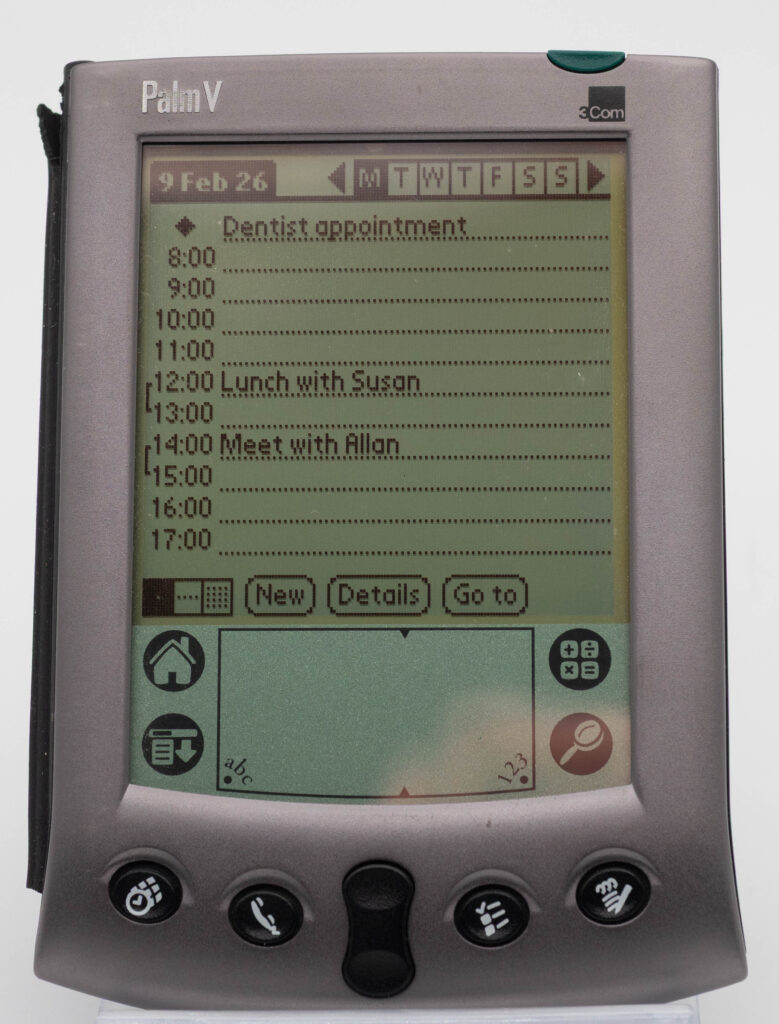
Despite the radically new form factor, the Palm V retained the familiar 160 × 160 pixel screen resolution. Unlike earlier models, however, the display now supported 16 levels of greyscale. Compared to the screen in the Palm III, the display was easier on the eyes and featured a new electroluminescent backlight that consumed less power than its predecessor. Unusually, the backlight illuminated the screen contents rather than the background, resulting in a reverse or “negative” image when activated.
Although the CPU clock frequency remained unchanged at 16 MHz, the Palm V introduced a new generation of the Motorola DragonBall processor, known as the DragonBall EZ. Reviews at the time noted that the new processor felt noticeably faster when performing tasks such as searching and sorting large datasets, despite running at the same clock speed as the earlier DragonBall. The DragonBall EZ also added support for DRAM and EDO memory. Another important change was that the operating system now resided in Flash memory, allowing the Palm OS to be upgraded after purchase.
User applications and data were stored in 2 MB of RAM, the same capacity as in the Palm III.
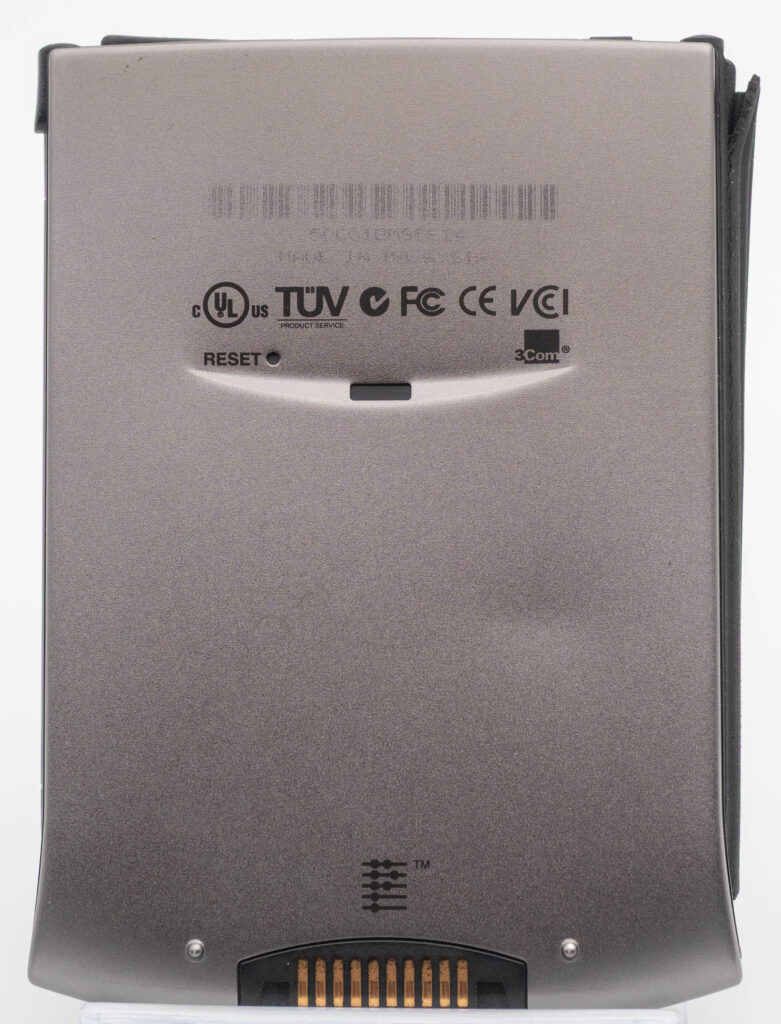
The redesigned casing unfortunately meant that existing docks and accessories were no longer compatible with the Palm V, necessitating an entirely new range of peripherals. One notable accessory introduced for the Palm III was Kodak’s PalmPix, a digital camera module that used the Palm as both viewfinder and storage device. PalmPix, however, was not compatible with the new Palm V.
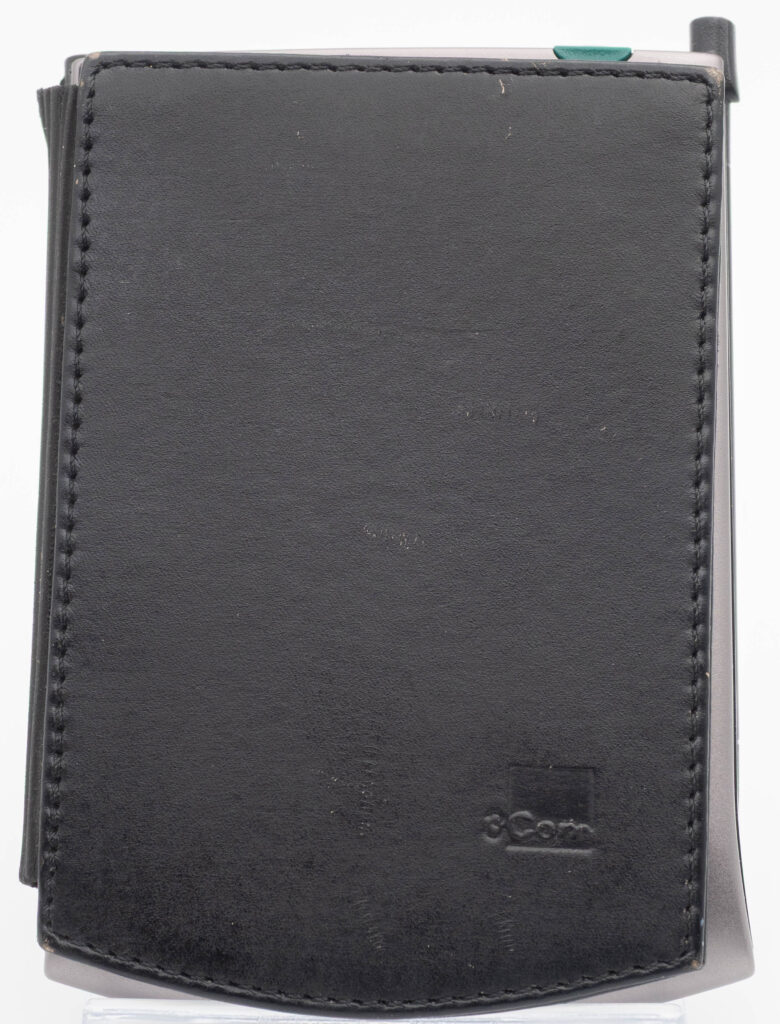
The Palm V also introduced a built-in leather cover for the display. While it contributed significantly to the device’s stylish appearance and offered practical protection for the screen, the cover was not universally appreciated. In certain situations it could press against the up/down buttons, unintentionally silencing alarms—a small but occasionally frustrating side effect of an otherwise elegant design choice. The cover could be removed completely if desired, as it slotted into the case, just like the stylus did.
The Palm V was very well received and helped cement Palm’s dominance of the PDA market at the turn of the millennium.
A fair question, really. I could have chosen either the Palm V or the Vx for the collection, as the two models are very similar in both appearance and functionality. For some reason, I ended up with both. In any case, the V and the Vx represent Palm at a point where the company had moved beyond early adopters and firmly into the mass market. They are both practical tools—and still a joy to look at.
References
Spec sheet for Palm V at phonedb.net
Overview of Palm OS powered devices at Wikipedia
The story about Palm and its PDAs, here at PDA Museum