
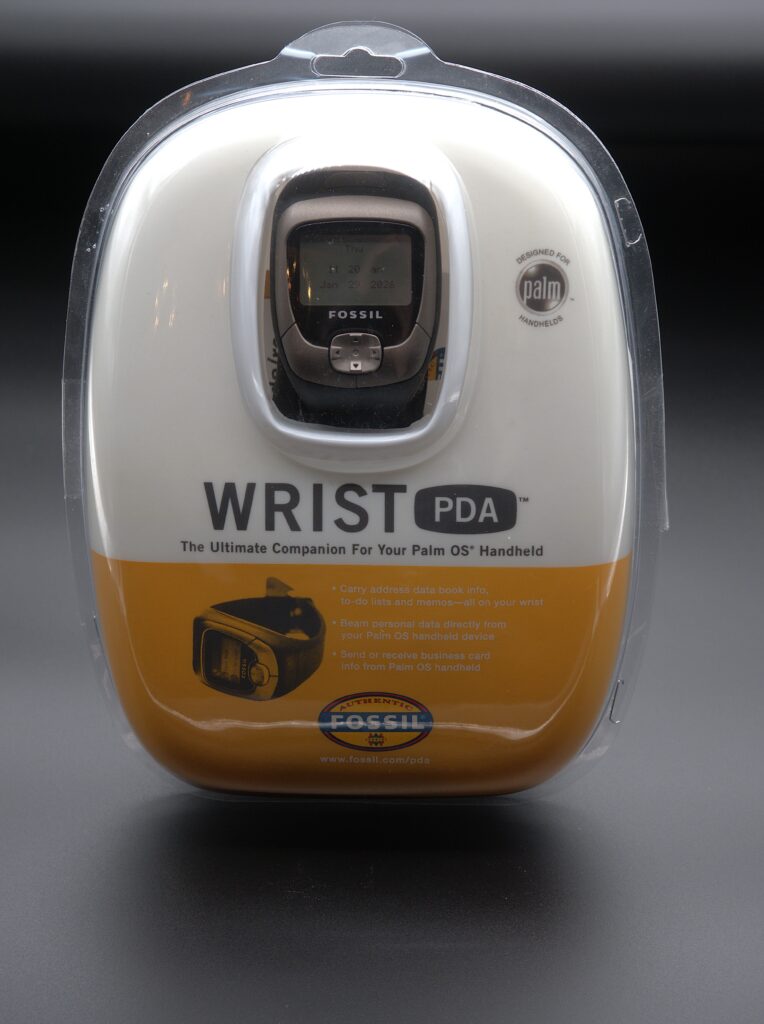
The Ultimate Companion for your Palm OS Handheld
Quick facts
- CPU:
- Unknown
- Storage (MB):
- 1.9 MB
- Display:
- ca 70x60 dot-matrix monochrome LCD
- Operating system:
- Unknown
- Year introduced:
- 2001
- Power source:
- 2xCR2032 Lithium cells
- Connectivity:
- Infrared
- Dimensions (mm):
- 45x60x15
- Weight (g):
- 86
- Built-in apps:
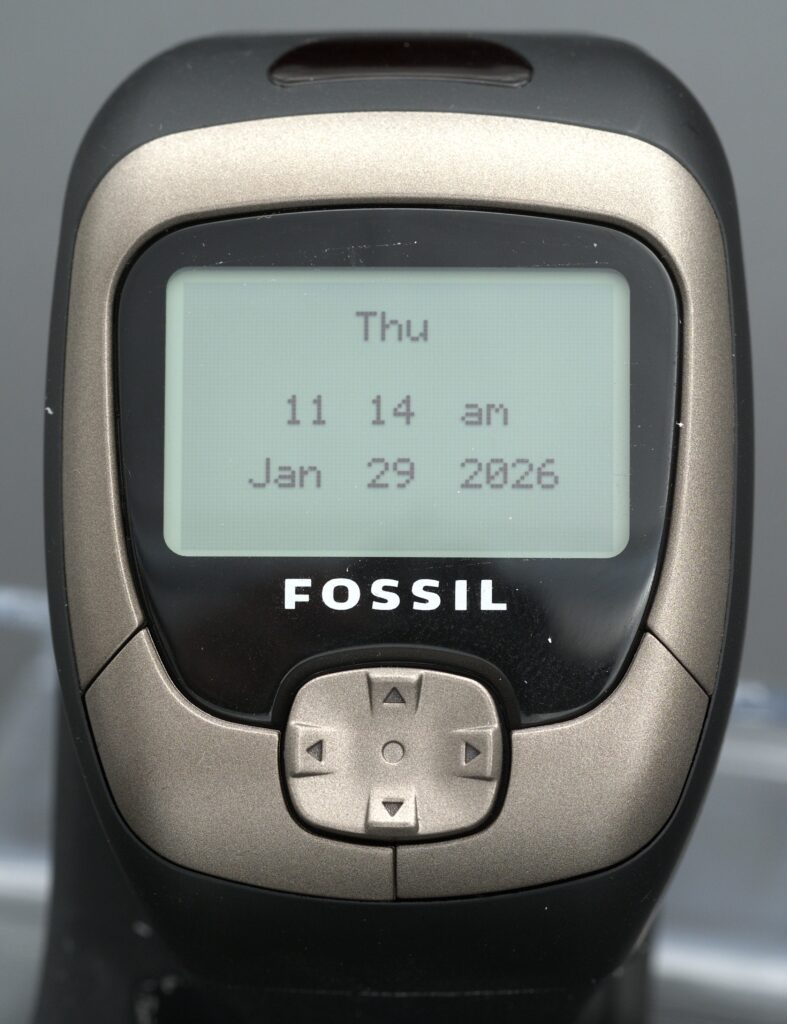
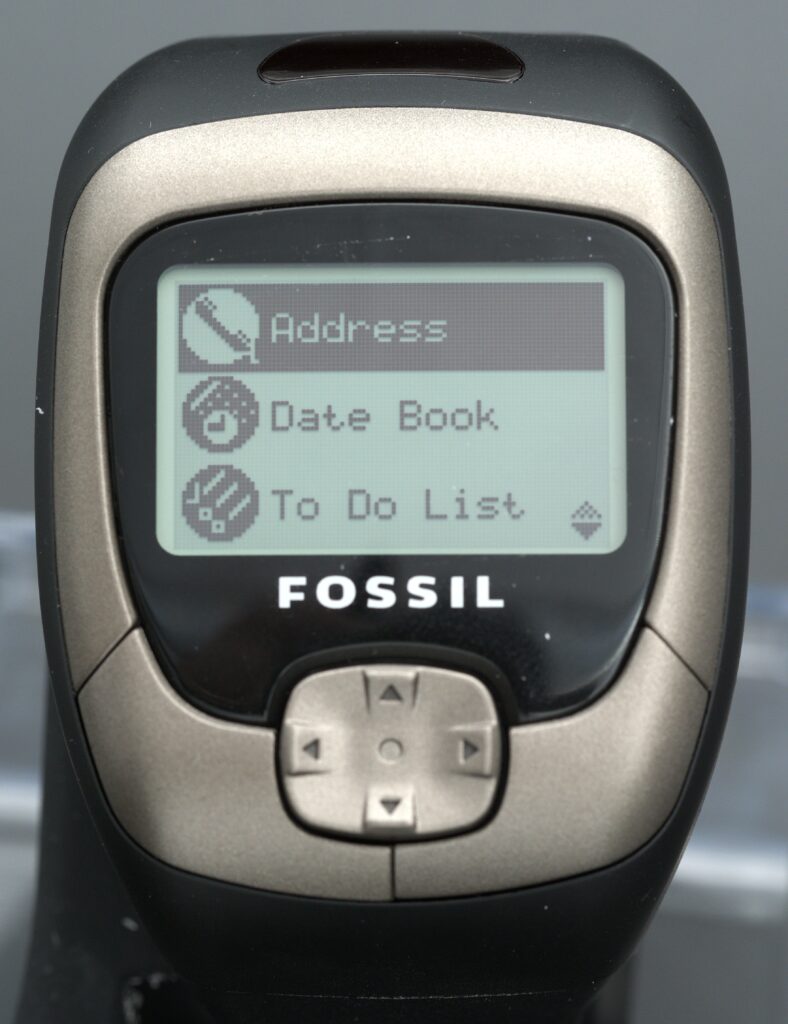
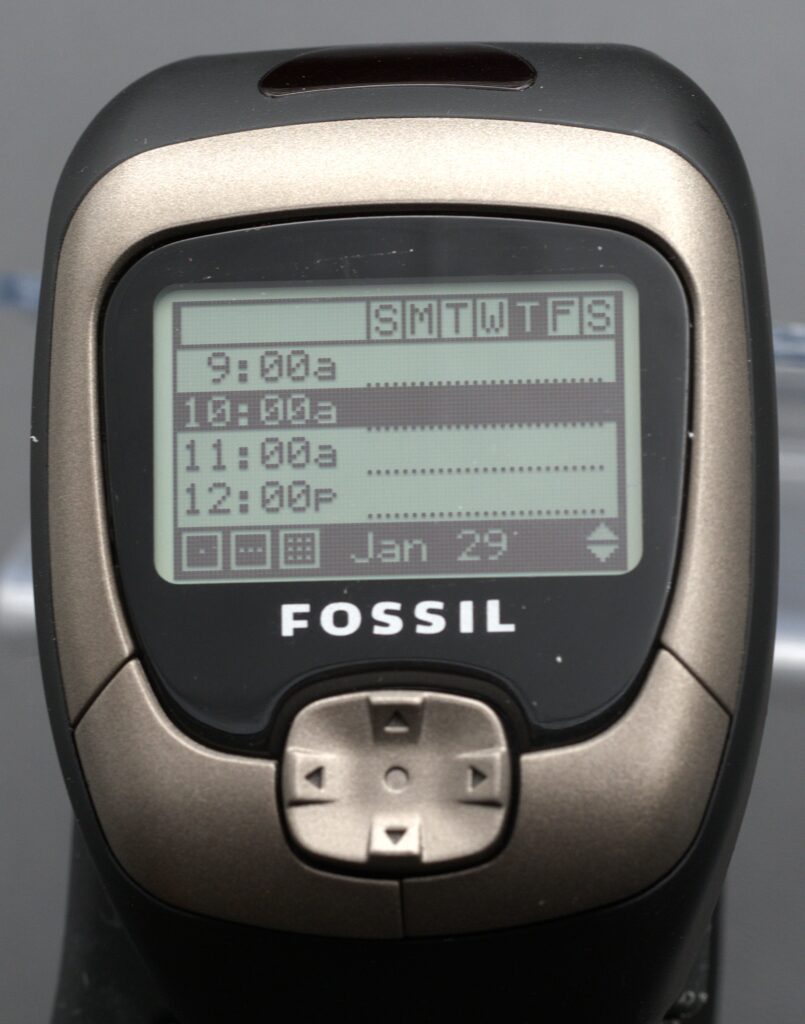
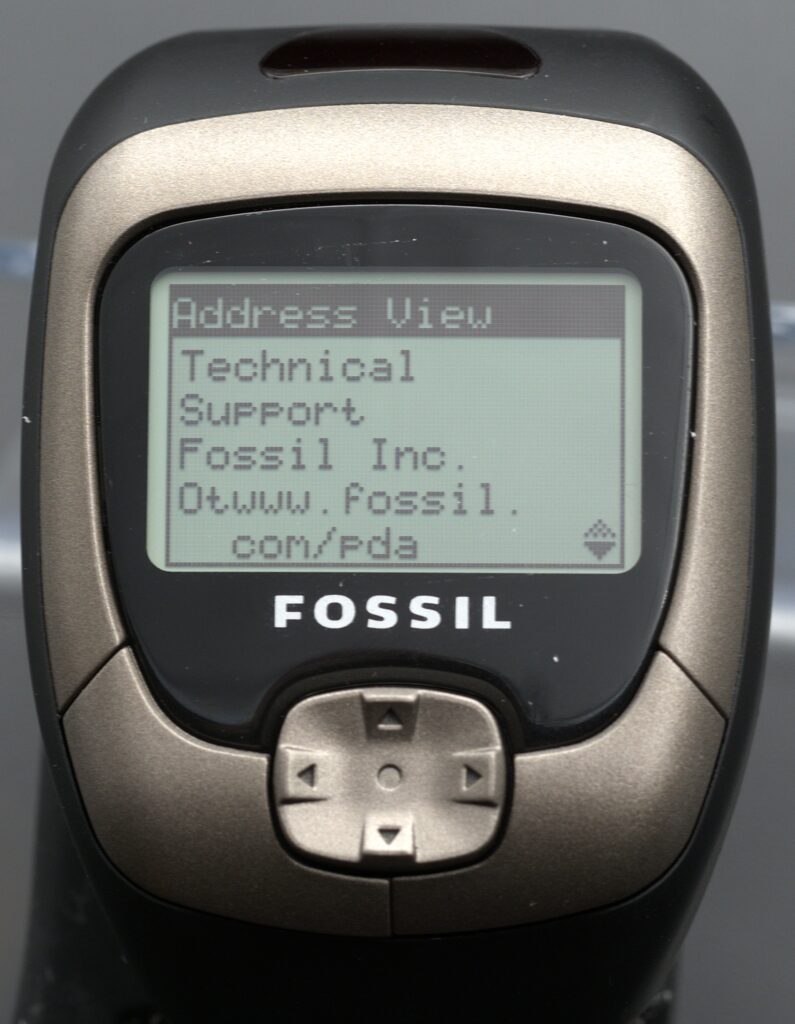
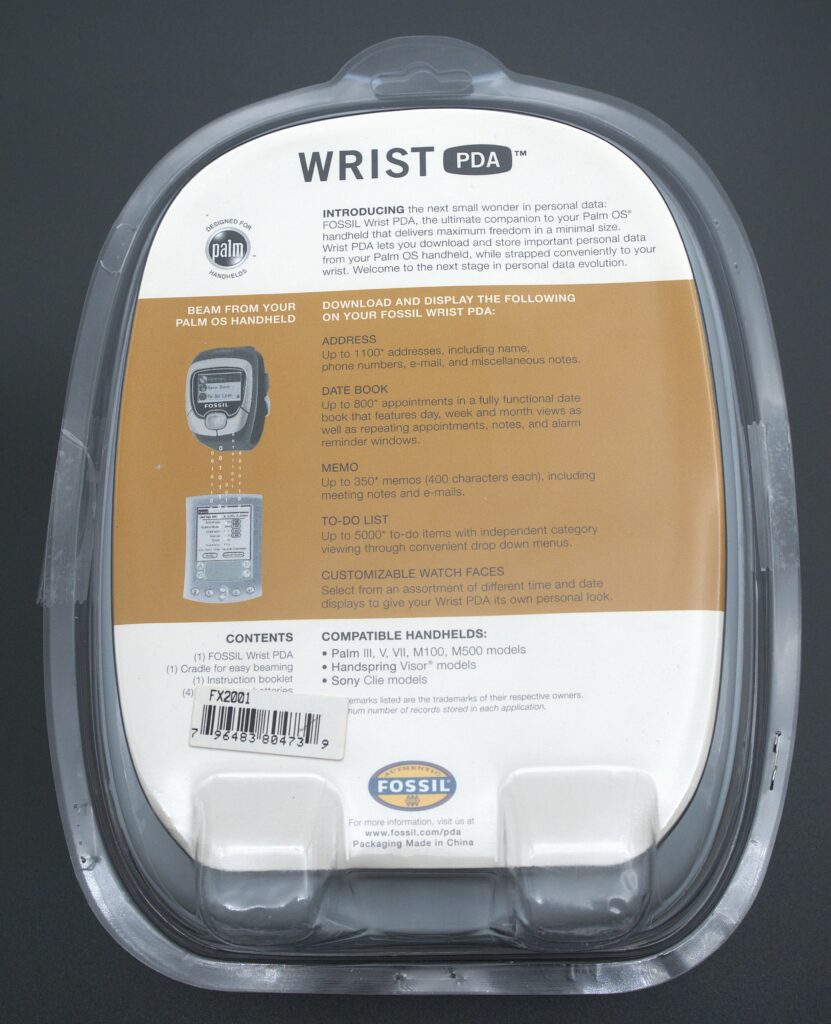
- Address, Date Book, Memo, To-Do List, Customizable Watch Face
- Input method:
- Joystick and buttons
Overview
At a time when a clear market leader had emerged — Palm, with its range of shirt-pocketable PalmPilots — several companies sought to enter the PDA space by doing something different rather than competing head-on. One such company was Fossil, primarily known as a manufacturer of watches and fashion accessories.
Publicly available information about Fossil’s early PDA ambitions is limited, so parts of the following account are necessarily interpretative. Fossil stated an intention to create a wrist-worn device running Palm OS, allowing users to perform many of the tasks for which a PalmPilot would otherwise be required. This proved more difficult than anticipated, however, and in order not to lose momentum, Fossil first introduced the Wrist PDA as a companion device for users who already owned a PalmPilot.
The Fossil Wrist PDA was compatible with several Palm OS handhelds, including the Palm III, V, Vx, m100, and m500, as well as devices from Handspring (Visor) and Sony (CLIÉ).
A few years later, in 2003, Fossil did release a series of watches that ran Palm OS natively. These models — known as AU5005, AU5006, AU5008, FX2008, and FX2009, and sometimes collectively referred to as Abacus — ran Palm OS 4.1 and represented a more ambitious, though still short-lived, attempt at wrist-based computing.
How it works
At the top of the watch is an infrared transceiver capable of sending and receiving data using the same infrared protocol employed by PalmPilots. Most Palm OS handhelds featured an infrared “beamer”, commonly used to exchange business cards or other personal information between devices.
The Fossil Wrist PDA made use of this capability in two distinct steps. First, an application named Fossil.prc was beamed from the watch to the PalmPilot. The watch stored this application in non-volatile memory, and Palm OS allowed applications — not only PIM data — to be transferred via infrared. Once installed on the PalmPilot, the Fossil application was used for all subsequent communication.
Data transfer was always one-way, from the PalmPilot to the watch. Rather than a true synchronization process, this was effectively an upload of selected information to the watch. The uploaded data could then be viewed on the watch’s small display and included contacts, phone numbers, appointments, meetings, and notes.
Navigation was performed using a four-way directional joystick combined with two buttons. Selections were made by pressing the joystick inward. In practice, the joystick proved imprecise, making accurate selection difficult and often frustrating.
The system also allowed users to beam alternative watch faces from the PalmPilot to the watch, although only a small number of such faces were available.
Commercial success?
There are no reliable sales figures available for the Fossil Wrist PDA or for Fossil’s later Palm OS-based watches. The product appears to have been a niche and short-lived experiment with limited market penetration. Fossil’s own financial reporting did not break out unit volumes for this product line, and as a result, exact sales numbers remain undocumented in publicly accessible sources.
Why it was not a brilliant idea
It is understandable that companies in this period were drawn to the success of the PalmPilot and sought ways to participate in the rapidly growing PDA market. Direct competition with Palm, however, would have been difficult, given Palm’s established dominance in pen-based handheld computing. Fossil’s response was to create a companion device rather than another standalone PDA — an idea conceptually similar to modern smartwatches.
In practice, however, the hardware and software of the early 2000s were not yet ready to support this vision. The Fossil Wrist PDA was physically large for a wristwatch, offered limited battery life, and featured a display too small to present information in a meaningful way. As a result, when users genuinely needed to check an appointment, address, or phone number, it was often easier to retrieve the PalmPilot itself, which offered a larger, clearer screen and a more usable interface.
As a watch, the Fossil Wrist PDA was also of questionable elegance, even when alternative watch faces were installed.
The Fossil Wrist PDA is a good example of a wearable device that solved no real problem. Its imprecise joystick made navigation frustrating, the display was too small to present meaningful information, and—most importantly—it depended entirely on a PalmPilot that was already portable enough to be carried in a pocket. Rather than complementing the handheld computer, the watch duplicated a small and significantly degraded subset of its functionality.